
A History of Scholarship on American Design

The Reminiscences of Suzanne E. Vanderbilt
Reminiscence from the 1985 Interview with Suzanne E. Vanderbilt. Automotive Design Oral History, Accession 1673. Benson Ford Research Center. The Henry Ford.
-1-
This is David Crippen of the Edsel B. Ford Design Center, and today is April 22, 1986, and we're talking today in beautiful West Bloomfield [Michigan] near Orchard Lake with Suzanne E. Vanderbilt, and this is a unique occasion for us because Suzanne was—until her retirement—a long-time staff designer for General Motors, and we are embarking, hopefully, on a series of interviews with female designers at the various automobile companies, and we are going to ask Ms. Vanderbilt to give us her career narrative at her own pace.
A: I was born in Mount Vernon, New York, but I grew up in Larchmont, New York, a suburb of New York City. After graduating from Mamaroneck High School in 1951, I went to Pratt Institute in Brooklyn, New York, and graduated from there in 1955 with a degree of Bachelor of Industrial Design.
Q: Tell us a bit about Pratt, could you Suzanne? A lot of our interviewees are Pratt graduates, and it seems to have been the incubator for a lot of industrial designers that migrated to the automobile industry.
A: Pratt was not an automotive design school as Art Center School was and still is. Pratt stressed basic design, empathic sketching, attention to detail, ideas, research with a real sympathy towards form and function. The engineering school was a great resource when help was needed for production answers. Rowena Reed Kostellow taught three-dimensional design, perhaps the most significant study for me. Learning to see through and around a form and studying the imaginative inner structure was fascinating. This led me to believe that designing and producing products for a silver company would be the place to begin a design career.
-2-
Q: How did that come about?
A: Let's back up a little bit. I really knew what I wanted to do, and that was to work with my hands as an artist. I knew that I did not want to teach. I did not want to learn to type, and, as a result, my mother said, "Oh my, deliver us from crazy artists!" That was her opinion, but she never really discouraged me until I wanted to take some art classes. She said, "Well, it's all right. We'll try it once." It turned out that piano lessons were cheaper. I doubt that. So, much against my will, I was taking piano lessons beginning in the second grade. The art classes were out. Mother was a musician and taught piano, so, maybe, that's why I was forced to do this. I spent a lot of time in the basement with my dad, who, at that time, imported all kinds of hand tools. He was very handy at building things and repairing toys, and I found that environment to be more to my liking. Pounding nails into a block of wood at about age six was the beginning of a special respect for tools and materials from wood to metal. Drawing filled any other free time I had. It wasn't something that I was forced to do, I did it because I had to. Today, I have the feeling that I'm more "Artist" than "Designer." Perhaps one expression overlaps another. Knowing by high school that I wanted to do something in the arts, I decided to take Mechanical Drawing. The school administration told me that class was not open to women.
Q: They were aghast?
A: They were aghast, and they said, "Women don't do that. They don't take Mechanical Drawing," and I said, "Then, why is a woman teaching it?" No answer was ever given, and, in those days, we did not question authority. Also, I loved anything mechanical, but the auto mechanics
-3-
class was closed to women. As a child, I used to disassemble watches, clocks, toys and anything that had a nut and bolt or screws to hold it together --I needed to know how things worked. With so many doors closed to women, I retreated to music—a proper ambition. It gave me a great background, and I use that now, but then I was heartbroken.
Q: These were administrative people at Mamaroneck who wouldn't let you take mechanical drawing?
A: Yes. Today, woman can be and do anything. You see, those were the—it's strange, but we've really come quite a long way when it hasn't been that long ago. The art class in high school was an elective in basic lettering. That is not what I wanted to do, but it was the only way I could get some feel for the mechanics of using a triangle and T square. When the art teacher said, "You'd better get married, don't go into art," that was discouraging. She then said, "Well, we'll give you a design project," and I thought, "Oh, good, this is more like it." She asked, "Would you design a cutting board for me?" At that point, I thought, this is really hopeless, and that was the extent of my art background from high school. I made a lot of posters and murals for various student activities, but doesn't everyone?
Q: And I called Mamaroneck a progressive high school a little while ago!
A: Not very. Industrial design was new to me. In the early 'Fifties I learn about Industrial Design through a friend of my father's. I told him of my interest in drawing and building things from airplanes and boat models to scaled-down airports. I'd never heard of industrial design, so
-4-
I did some research on my own. Prior to that, I thought medical art would be terrific because I could combine my interest in medicine with drawing. I realized that television would, perhaps, replace the artist, and I did not want to just illustrate technical research books. Industrial design was new, and it just happened that our next door neighbor, Rosalyn Frank, a graduate of Pratt, but in a different department, said, "Why don't you write Mr. Boudreau," who was then head of the art school, "and find what you need to know about it." I sent an application to the art school, visited the school with a rather humble portfolio, passed a drawing test and was accepted. To get into the Industrial Design Department, a mandatory one year of basic design had to be completed with above-average grades in the design program. Today's standards are different. The entrance drawing requirements were a drawing of your iron, a piece of furniture, an interior of your living room, and an illustration of an exciting experience.
Q: What well-known industrial designers were on the faculty in those days?
A: Rowena and Alexander Kostellow. He was the head of the Industrial Design Department at that time. They were instrumental in keeping me interested because they were both excellent teachers, and Rowena urged me to go to G.M. I recall some of his classes where we would put our sketches on the wall (this was after I was accepted into industrial design). The wall was covered with what we thought were wonderful sketches. This was our first year of industrial design, and he was teaching us an empathetic sketching technique—how to shade something with a Conte crayon, but do it very quickly, and he came in and out of all of these sketches which we had to put up with mat tacks
-5-
in a certain way, and of course, we didn't know why, but later found out it was because he would rip everything off the wall and walk on it if he didn't like it. And, he said, "You know," in his accent, and I won't try to mimic that, he said, "You students fall in love with your work. You can't do that." And, it wasn't until much later that I realized the reason for that is when you get out and you are competing with Art Center and Illinois Institute and all the other schools, you'd better be ready for it because so many times you are trying to compete with people who are far better than you are in certain areas. Pratt, at that time, was not well known for slick renderings, but we had ideas, and we had marvelous, I think, background in sketch technique. I do believe in our class—1955—there are a number of people who have done extremely well. What ultimately convinced me to come here was a discussion with Rowena Kostellow. She talked to about four or five of us and convinced me that this was a special opportunity.
Q: What had been your major at Pratt?
A: Industrial Design. This includes a variety of subjects. We should be able to design just about anything. Now, I think, it may be different, but in those days if automotive design had been offered at Pratt, I probably would have looked into it, but not made it my major. I wanted to combine the mechanical and aesthetic aspect of design. Automotive design eventually fulfilled that. I remember Mr. Tom Christiansen and Dave Wheeler interviewed us at Pratt, and I did whip together a portfolio, and they came out and said, "Well, we will offer this amount of money, and you can start July 5th." It was so simple.
Q: Who were they connected with?
-6-
A: General Motors. Tom Christiansen was, at that time, I believe, in personnel, and Dave Wheeler, a designer. Maybe he was a designer that they felt would have some feel for the industrial design department. They just have various people who they send out, and, subsequently, I found out it was people who could talk to these students and had some rapport with them. They weren't old, and they weren't too young, and yet they represented, at that time, the biggest corporation in the country.
Q: Well, this is an institute—Pratt—which was a major industrial design learning center but did not have an automobile design orientation.
A: No, it did not. Not until later.
Q: In '55. And, yet G.M. and other automobile companies were interested in some of their top graduates?
A: That's right, and I think it might have been because of the ideas that we had. The education was supportive of the creative spirit. Since there were other women who were willing to take a chance and drive out here in an old car and set up housekeeping. I decided, well, I'll try it. But, I think, if I had had to come alone, I would not have done it.
Q: So Christiansen and Dave Wheeler induced you to—did he look at your portfolio at that time?
A: Yes, oh yes.
Q: And, he said, "Come on out. We have something for you," or that he might have something?
A: Well, they said we would get back with you, and they wrote a very
-7-
nice letter using "he" a lot. And, in other words, we are offering you X amount of dollars a month which sounded like a million to me. And the problem was getting here rather quickly after graduation. There was no time to stop, and within a few months, we were on overtime, and I got a good taste of what it was like to work for a big corporation.
Q: Who came with you?
A: The first group of three were Jan Krebs, at that time—now Jan Lapine, and Ruth Glennie Peterson. We drove out in about '39. Dagmar Arnold joined us later in the Summer. Ruth put new shock absorbers on the rear of her car. Little did we know that it was to have the rear end high and the nose to the ground, and it was very uncomfortable riding on that angle. We arrived July 5th—one of the hottest days of the year, ever. Drove down Cass Avenue to the Priscilla Inn—the three of us. I hope I never have to go back there. I believe it's still there. It's across from the Masonic Temple, and that was the only good part is that we got to see a lot of wonderful things—music.
Q: By registering there, that was your home?
A: For awhile, until the Tech Center got us here by saying we will—or that G.M. really enticed us to come because they said we would be moving to a Tech Center—beautiful place out in the country. [Warren]
Q: Where did they put you, initially? On the Boulevard?
A: Yes, we were at the G.M. Building which is down on Grand Boulevard.
Q: What department were you in there?
A: Well, they did set us up in the automotive interior design department right away. And, subsequently, Dagmar Arnold came out, but she came
-8-
under her own steam and was in another area. She was in the industrial design area and worked on kitchens.
Q: Came out from Pratt?
A: Yes. She is now working at IBM but has made many stops along the way.
Q: Were you something of an exotic sight for male designers?
A: Well, we took a lot of ribbing, of course, and…
Q: What sort of reaction did you get?
A: Well, I think, there probably was somewhat of a feeling of "Oh, well, this won't last."
Q: Really? "They'll get discouraged and leave?"
A: Yes. And, you know, we were young, and I was terribly skinny and not too happy about the whole living situation which made work a little more difficult. But, I think, one thing that I didn't have was the technique of finished, polished renderings that the Art Center people had, so I made all my sketches in water color, and that, I guess, got most people quite hysterical because one day one of the bosses came in and said, "Well, maybe you've got something there. Let's see what we can do with it," and they threatened to send that water color sketch down to the shop to see if they could build it. And my heart sunk. Don't know what ever happened to it. I think they kept it, you know, for posterity, maybe. I never saw it again.
Q: You've never seen it since?
A: No. But, the ideas were there, and that's what was important. But, I'll tell you, you learn very, very fast, and it wasn't more than a few months, and we could do just as well as some of the men, I must say,
-9-
and we started out on quarter scale which they don't do now. They have people who do that for you. So, we really leaned form ground one how to put the car together, and that meant as an interior design in the seats and the doors on, of course. The instrument panel at that time was not part of our area but, eventually, we did get to work on it. But, those were the days when, I think, very much—well, many days—or many times we've had a misconception about interior designers, meaning you just select fabrics and sew things together—just as interior "decorators" do, but there's a lot more to it than that, and that's what we tried to tell the press over and over again. We weren't there just to decorate. Unfortunately, the projects that were publicized were decorating. We did not have a chance to redesign an instrument panel. We just suggested color. The trim design would change. New fabrics and leathers and, perhaps, some innovations and new carpeting which they couldn't afford to do in production. And, I think, that is—that went on for a number of years until they realized that there was more to it than that, and we just asked for more work and asked for more specific things. And, that—after a few of the show cars that we did, I recall being called in to do some of the government cars when we used to build cars for the Army and the Navy. But, again, it was strictly color and trim.
Q: So, you find yourself up against what has now become a cliche that lady designers could only handle interior fabrics and color.
A: That's right, that's right.
Q: You said you did work on the dash.
A: Well, we did later on, but I think it was very, very late into my career there that I actually did.
-10-
Q: The hardware?
A: Yes. Research—and when I was in the research studios, they were more interested in the total car rather than just the inside and the outside. We talked about the total, and I enjoyed working there very much. But, that was my first taste of instrument panel work.
Q: What studio were you in in the very first days? You mentioned Chevrolet was your first.
A: Yes, that was really the first assignment. That's when we were down at the General Motors—down in Detroit at the G.M. Building, and really it was an orientation time. Very quickly they would run through the present proposals, and then they'd get a reaction from us, and I didn't like anything, of course. And, then we'd go from there to what they were working on. It was always two years ahead, so we had three/four years to look at, and, I think, the boss—my boss—I can't remember his name. Well, the main design executive at that time was Henry Lauve. Anyway, I remember the boss' name who was head of Chevrolet [studio] at the time was Ken. I don't remember his last name, but he was testing all the time just to see if I had any taste at all, and, so, maybe, in away, it was good. We did do the quarter scales which meant [when] we'd have an idea, we'd put it down, with very hard lines, and also collect fabrics that would work well with it, and then we could see it put together. The instrument panels in those days—all of the clay models were in one room. All the interior design departments were in one room, whereas now they have separate studios, and they're locked—no problem then going from one to another, although they didn't like it. But, that was really all aspects. We did full-size drawings with seats and doors and all the parts, as I recall, except the instrument panel.
-11-
Q: And you were doing—did you say 3/8th's scale—were you doing the actual models?
A: No, quarter scale. No, this was strictly on paper—hard lines.
Q: And, they would be sent to the modelers.
A: Or to the people that would build them. They build seats and doors, believe it or not, as prototypes from those drawings, so they had to be quite accurate. Then, eventually, Fisher Body gets those, and they make another prototype. That's the way it goes. But, I think the idea of moving, as I did, from one area to another, within a corporation like that gave me a tremendous background, because if you go to an industrial design firm, and you just do one thing day in and day out, it gets very, very boring, and I liked to move and learn new things. Then I moved from '55 to '56, I was in Chevrolet interiors. Then I went to Cadillac.
Q: Why was that? What happened there?
A: Well, it's just a natural attrition. It's sort of, as in most of those studios, they like to keep people moving in the production studios, and so you're never there—in one area—too long. You may eventually come back to that, but you don't stay there long.
Q: They don't want you to stagnate?
A: No. So, then, at that time, I— my boss in Cadillac had an automobile accident.
Q: Who was that?
A: Robert Scheelk, and I was the only person in there that had had a few years of background, and so I had to assume the assistant—normally there would be a chief designer in those days, and that was it, and all
-12-
the drawings, but in order to have somebody answer the phones and answer questions, they had to assume an assistant chief designer, so at a very young age, I got a good taste of what it was like to…
Q: That's marvelous.
A: Yes, it was exciting. But, you know, you're doing 100% plus time, and so, when he came back, then I could relax again, but it was wonderful because I could meet the managers—the general managers—and I'll think of those names. Bob Ahrens, I think, was the general manager.
Q: The general manager of Cadillac in those days?
A: Yes, then, subsequently, it was Mr. Jim Roche. And, so when you're selling something, to meet these men at that age, it was, you know, you're nervous, but…
Q: That was a period of about six months, wasn't it?
A: Yes. That was a short time. Well, a year anyway.
Q: Scheelk did recover, though, and came back?
A: Oh, yes. It was just a few months, but it was a wonderful experience for me, and then, I think, I was the one who said, "Okay, enough of this production work. I'd like to see what it's like in the research studio." So I found my way down there.
Q: That was their advanced studio?
A: Yes, and Bob McLean was head of it. I think he died recently, but Stephan Habsburg, Who was his assistant and in charge of that studio, and I just feel that they had meetings where they would brainstorm and think-tank almost, and that was exciting for me, because after you're in production for awhile, it becomes monotonous. So, not that it isn't busy, it's the same over and over again. So, we were—I came in the midst
-13-
of the finishing of the Firebird III, and, as I told you before, I did—they were hesitant to give me much to do except an arm rest and a little doorknob or something, so I felt I had some part in the Firebird III, but that was pretty well completed by the time I got there.
Q: That was one of their theme cars? Concept cars?
A: Yes, that's right.
Q: Let me ask you, if I may, Suzanne, at this early stage of your career, how did you feel about automotive design? Was it an exciting prospect? Obviously, it was.
A: Yes.
Q: But, were you discouraged about the possible lack of advancement in terms of salary grade and responsibility that was available to women in automotive design?
A: Well, I didn't even ask the question, is there anything? I mean is there an area where I could excel as far as going up the ladder, if that's what you mean, from junior designer, to senior designer. I didn't ask that question because I just wanted to be a good designer, and that may sound kind of silly right now, but that is all I wanted to do, and I enjoyed and loved what I was doing after I got into it. I had only planned to stay a year or two, and I ended up [staying] twenty-three years, so, obviously, I enjoyed it or I would not have stayed. But, I was never asked that question as they do now, or even then of the men, what do you want to be, and if you say vice-president, that's wonderful. I didn't think I'd ever even have the opportunity. That's not the way it worked then, so I just realized that after being there a number of years, and my salary was not on a level with some of the men, I thought, well,
-14-
in order to do that, I'm going to have to be a senior designer and assistant designer and/or a chief designer, and, to tell you the truth, I never really needed or wanted that. But in order to survive the cost-of- living changes and have a place of my own, I accepted it, and after each acceptance, I enjoyed what I was doing more and more. But, we were never, unfortunately, trained for that. You know, we were not trained, for management positions. We learned that on the way up.
Q: Interesting that you were a dedicated assistant chief designer of the Cadillac studio. I think that's quite a coup for a young—forgive me—female designer at that time.
A: That's true, that's true, but what did I know? And, I think that probably, without realizing it, I was very competitive, and again, without realizing it, very aggressive.
Q: And you obviously had talent.
A: Well, I didn’t know what it meant to have talent, and if you could put it down on paper, it was one thing; if you could sell it, it was another, and I thought that was terrific. If what I wanted it to look like or be for the car and be able to sell that to the general managers, and they would agree, I had some satisfaction. I really got a great deal of satisfaction, and, I guess, that's what makes it go around, isn't it?
Q: It sure is. So, you're now in late '58, and you're having a marvelous time with the General Motors advanced studio at the time, you were about to tell us about some of the techniques of brainstorming and how you came up with advanced designs.
A: Well, it was always a group effort. Not anything that would bring laurels to one person, and I thought that was the best way to operate. I
-15-
still believe that. There may be one design, and people will talk about that forever. That there is one person who comes up with it, and then eighteen people put it together, but I do think we must open our discussions for design to many people and for many areas, and that's what we were doing. We had interior designers, exterior designers, human factors, personnel [with] a lot of different backgrounds, engineers, draftsmen, and people who knew about materials. We had a tremendous number of talented people, and for me it was just absolutely exciting. It really was, and I thoroughly enjoyed it because we could come up with an idea, and in those days—within limits—if I could order eighteen splines of wood that might be 2" x 81, you know how floppy they could be. I just could use masking tape and tape these together into a form that was something you could sit in without the union coming down on us— "Oh, oh, she's doing it again!" So we would have them build a major structure like a center spline—maybe a 4x4.
Q: Would you explain what a spline is?
A: Well, it's just a flexible piece of wood like you call slatting now for a house, and usually 1/8 inch by an inch and a half wide, and, at that length, 18 feet or whatever it might be, it becomes very floppy, and you just take these things without nails—you couldn't pick up a hammer, you see—and we did an awful lot of taping and a little bit of gluing here and there to get a feel for a vehicle. And, at that time, we were working on Autoline which, subsequently, became a research—a report that Bob McLean gave to the Engineering Society in Detroit, and I would have those dates in other places as we go along, but I that was the first exciting, total car concept that we had where we had
-16-
designed or thought of a linear electric motor, and don't ask me how that works. Take my word for it, they had it, and that was Bob McLean's input into this, and we thought that we needed a vehicle that would be on a system with wheels up against a trough with the linear electric motor, and as you come off or on the system, the wheels were down, and you drive it just like you would a car today. But, the exciting thing then was, and I still have a thorn in my side because of it, not too long ago, not more than a few weeks ago, I noticed in the newspaper—not only Ford, but General Motors—had described a system that they are still working on but could be available soon, where you know where your car is on the road with a [viewing] screen. And I could show you drawings that I made, and this is not patting myself on the back, I just find it very amusing, where I had this cylinder set up in front of what would have been the driver's situation—not necessarily a steering wheel, whereby you buy, in those days, a triptik from your AAA, if I could use that word. And I pictured it on a scroll, but that it would be magnified in certain situations on this system, so you knew where you were all the time, you knew where the vehicle was, you would know if you had to get off the system for whatever reason what the situation was in traffic and that kind of thing. But, you know, they couldn't build the thing because we didn't know how. We didn't have the electronics.
Q: The technology?
A: I find that to be true right down the line because—especially in research. We could propose it, but we couldn't build it. And, now when I see it, the hackles go up and say, "Darn it, we should have really hung in there." And, the other one, which is more recent, and you
-17-
will remember this, is the inflatable seat back support. I have a patent on that with General Motors, and the only reason I'm telling you that is for this particular situation that we're going through now, and I don't talk about it, but when I proposed that, there was very little interest.
Q: What year was that?
A: I presented that in 1964 at the Orthopedic Surgeons meeting, but…
Q: That's right, their whole seating study was presented by request at the National Meeting of Orthopedic Surgeons in 1964.
A: That's right.
Q: Was this quite revolutionary at the time?
A: Oh, yes, because we made that so that it would fit the current, at the time, springs and foam and that kind of thing situation—stuffing in the seat, and today they don't use that, but it would have been easy to do, and it was tested at the proving grounds, but we're right back to money again. But, the funny part of it was, a few months ago—one of the chief designers stopped over with a new car, visited for a little while, and I said, "What's that switch up on the seat cushion?" You know they built up the side of the seat. "Oh," he said, "well, let me tell you about that," and he told me it was part of this lumbar support—inflatable lumbar—and I said, "Isn't that interesting. Where do you suppose that came from?" He said, "Well, I don't know, but we've been working on it." I said, "Guess who has the patent?" And, of course, his face was red. I'm sure they've made modifications, but, again, they weren't ready for this. The only problem with this is that it took me a number of years to
-18-
develop this with the help of Peter Kyropolous who was then technical director of G.M. design staff, and we were getting more and more involved in human factors and safety at that time, and we felt if we could enhance the system in any way that we could, this would be one way is to make people more comfortable. We found people taking old slippers and rags and pillows and putting them at the lumbar spine, but the mistake that they made when they took it out to the proving grounds to test this was they felt they had to feel it in order to have it work, and that's not the case. With the research we made, you don't need more than about 1/4 of an inch or less of dimension to change the attitude of this lumbar support, and you have it in the thoracic or lumbar or the sacra—we had three of ingredients.
Q: Three positions?
A: Oh yes, but…
Q: What was the basic principle?
A: Well, it was—if you mean the construction of it, it was just three horizontal tubes of rubber—each could be inflated separately or together with what amounted to be a window switch at that time which activated a little motor that pumped air, but you could also do it the simple way and use a blood pressure mechanism, you know, like they just use a bulb, and that was simple, you could pump up, feel it and then let the air out, and we had three of those, and I have photographs, and I have the patents, and I just think to myself that really is funny. I got a dollar for my effort, though.
Q: That was your only royalty?
A: Oh, yes.
-19-
Q: The company has taken the royalties?
A: Well, they didn't because they didn't produce it. It went outside, yes, and I think they might have let the medical field have it, because we did work with an orthopedic surgeon who wanted to give it to some of his patients. Now, things are not meant to be a criticism of General Motors or any corporation. It would happen anywhere, but it was just the fact, I felt, it's because it's a woman that has thought of this, and we have a lot of men here who are doing the same thing—research—but, haven't come up with that.
Q: What about Kyropolous? Wasn't he supportive?
A: Well, he was supportive, but, again, we had to go on the—or, as far as tests went, it was not approved, so that was the end of that.
Q: What happened at the test at the proving grounds? Where was it by the way?
A: It was out at the Milford [Michigan] proving ground. I have the research report on that. I can show it to you. I don't know it by heart, but…
Q: Well, basically, what happened?
A: Well, they didn't feel that it was comfortable, but, you see, you don't hand it to someone else who has not designed it who had—you see, everybody is a different dimension, too—sitting dimension. When you sit down, if you're very heavy, you don't displace the seat the same as if you're very thin. It's the same process of women with heels that per square inch poundage on one little quarter-inch heel is much greater than if you wore a flat, wide shoe. So, it's the same principle, you don't deflect the seat as much.
-20-
Q: Did you have people in the orthopedic profession giving you support?
A: Oh yes. Dr. Esslinger, who at that time was an orthopedic surgeon, was our consultant—paid consultant. I don't believe he practices here any more, but he was at Beaumont [Hospital] at the time, and he's the one that gave us the support and was interested, and I learned probably as much about the vertebral column and all its related parts as I could. And, I have a book that's a complete work on that so other people could carry on from that. We knew that seat cushions, for example—the ischial tuberosities are the points under your bottom that are—these are things that become sore if you ride a bicycle on a hard seat. Well, in order to take some of the pressure off of that, I learned that if you were to cut, let's say varying dimensions or a hole where those two areas would most likely be for most people, you could take the pressure off. Because the only reason we squirm and move around is because we're uncomfortable. Something really is hurting, and short of sitting in a bowl full of jello—you know what I'm saying. And, in the research studio we designed other things where you could have one fiberglass shape all in one piece and then have little sections that would inflate and deflate depending on the person themselves, so you'd always have a seat that would accommodate everyone so you don't have to blow these up. I mean, all of these things had to be keyed to either research or to production, and I could go on for days about the things I feel would still be an advantage today short of growing, and I'm not kidding, growing a seat! We even talked about if you went to a dealer, for example, and you said, "I'm five feet five, and I weigh so much," that sooner or later he would be able to order you a specific seat.
-21-
Q: Molded to your specifications.
A: Right. But, with your situation of four different drivers, what are you going to do? Well, that's where all or these changes would have occurred—program changes, and I'm sure they could do it now, but it's very expensive.
Q: But, in those days, it's odd that the proving ground would have been the place where the final test results were decided. It must have been very frustrating for you.
A: Oh, yes. But, I just moved on to another area. I kept trying.
Q: Well, let's try and follow this up. So, the project was…
A: It was dead.
Q: It was dead, and for money and for other complicated reasons in terms of multiple drivers, but…
A: Oh, no, we could have solved multiple drivers. It was just not comfortable for whoever tested it.
Q: Did you find out who that was?
A: I could probably find that, yes, but I would not want to put him on the spot, because he could…
Q: Was he a head of the testing program out there?
A: He was probably not a head. He probably was a hired driver that was part of the General Motors team, and I was surprised that they didn't invite me to go out and talk to them about and discuss it and try to make them understand that this was a subjective [conception], but objective results should be expected, and I'm sure they pumped it up too hard. And, naturally, if you get something too hard, it's going to hurt, and they didn't read my instructions, that's for sure.
-22-
Q: This was almost 30 years ago. It's understandable that there was not the sensitivity to human factors or ergonomics that you have today, but it seems incredible even today that they would entrust it to a non—just someone who said, "I'm uncomfortable."
A: Well, I think this comes from the top. I think, maybe, they, in a way, felt that unless a production studio executive pushed it, they weren't going to spend any more research dollars on it. I think it comes down to money each time and production.
Q: Who was the head of the advanced studio?
A: Well, we reported, and the words would come yes and no from Steve McDaniel who was then chief of interior design—totally interior design.
Q: But, were you able to interest him in this at all? Was he sympathetic?
A: I don't believe so.
Q: So, that was it. It was dead.
A: Well, you don't question it. In those days, you see, you didn't question authority. And, again, a woman respecting authority, and, again—I hate to keep saying "those days," it sounds really archaic. I think today I would say, "Now, just a minute, I have proof," or "Let me further test this," or "Give me my own time," or whatever it would take to do it, and besides…
Q: Did you get royalties?
A: No, oh, never.
Q: You just didn't?
A: No, because it sounded like the authorities had put a stamp on it
-23-
and said no. And, I don't know who resurrected it, and I don't know how it got back into automotive, and I don't know what form it is. I don't take the seats apart anymore, I don't look at it. All I know is that somebody's using it, and they're making some money on it, and I don't know whether they had to pay to get it back or if they ever let it out, and I really don't care. The main thing is that if people can be more comfortable in driving situations, then I feel happy about it. And, if, in fact, we ever get this—I'll call it the [electronic] triptik because that's what it was then—wonderful, but I just laugh inside a little bit that we—until we went to the moon, I guess, we didn't know how to do these things. So, it was discouraging in some areas in research because we didn't know how to put them into production. Whereas in production, you did what we knew how to do, and, at least, in two years or so it's out on the road. So, that was satisfying.
Q: You, obviously, were something of a visionary in those days.
A: Well, I think, throughout my whole life I have always thought ahead, and that's not being egotistical—maybe it is—but I will not stand for—today. I always try to think about tomorrow and what we have to do. In my present situation, I have to live each day by day, but I'm always thinking a few years down the road. You know, what will I be doing?
Q: The triptik that you described earlier, was that a visual—did you say, a visual map reading device?
A: Oh, yes, and you could plug a…
Q: Was there a precedent, a model?
A: We didn't have anything to go on.
-24-
Q: Just the principle?
A: The principle of it, and I have the drawings. I still have the drawings somewhere.
Q: Do you have a patent on that?
A: No. In the research studio we didn't do that. In production areas we did get patents on things. But, after awhile, I caught on to that game, too, and it would seem that the more patents you could come up which meant simply calling one of their patent attorneys and say, "I think I've got an idea," that's how people made little bonuses. But, I decided, once I found that out, that wasn't important, so I didn't fight with that or [that] everything could be patentable.
Q: But, it was the unwritten law in the advanced studio that you did not patent ideas that came up from advanced...?
A: Oh, no, no. The research studio is the brainstorming. The advanced studio was directed primarily to interior design studio, and that's where we got into the safety and these lateral supports. I also worked on a collapsible switch. I think it was—was it Packard Electric—and have a patent on that, too, and that might have been used. I don't recall. You know, after you've done it, go on to the next thing.
Q: You called it a safety switch. How did that work?
A: Well, it was taking the—we could not change the design per se—everything had to happen behind the instrument panel, so it was simply a breakaway. As you hit it, it broke a little ring and went on through to the instrument panel because we found if you were strapped in, at that time with lap belt only, on a front impact you would slide forward, and
-25-
your knees would hit something, then you would pivot up, and your head would hit something, and, so, in those days we tried to take care of things that were in the way. So, the first thing I attacked, naturally, would be something that you hit first, and I don't even recall whether we ever got into that. But, it would be like a lighter, you know, when you press the lighter in, it goes out of the way.
Q: Recessed?
A: Yes, but it would never pop out again. This thing would stay in there jammed, but it could be repaired because they didn't want to lose, maybe, some of that.
Q: What did it affect—the switch itself?
A: Could be any knob on the instrument panel—it could have been lights…
Q: Life-threatening?
A: Well, you try to get away from that, you know, the knobs have to be checked out for the various things, and I did work on a lot of that. We had [an] occasion to—I had [an] occasion to go to New York and work with a group who designed dummies, and at that time they had not thought of Oscar and skin. We had to design with Mr. Charles Gad at the research studios, or the research development area at G.M., a skin that you could put on top of these dummies so that we could better check lacerations and skin problems from accidents. So, there was a lot of work going on then. It's just that it was hard to get it going. I hope we don't get sued.
Q: This is very interesting that you're working on safety and human factors fairly early, I would say.
A: 1961. But, I was directed to do this too. You know, this was not
-26-
— it wasn't something that I thought of to do, but it ties in with making controls easier to reach. That's all part of it, because as the cars were coming down in size and getting smaller even then, we had to make sure we could get people in and out and weren't bumping heads, and we could still reach controls. I found that fascinating. But, as you can see, I moved on.
Q: This is under the direction of Dr. Peter Kyropolous?
A: And, that I was doing at the same time I was doing production work for Steve McDaniel. I always seemed to get a little extra work, but that was all right.
Q: What do you mean by mutual development? What aspect of that was part of your training? This is under your work experience in '60/'61.
A: That's with the research department.
Q: It was a combined area?
A: Well, it wasn't within design staff. This is the research group that was across the lake, so we worked with them as well. It was fascinating.
Q: In terms of...?
A: Testing.
Q: The human environment?
A: Vest testing. And, then Kyropolous did set up a human factors and safety department and, I believe, Ron Row had a lot to do with that and Stephan Hapsburg. So, then we had a full-fledged human factors group going.
Q: That's very exciting to think back on—at this early date this conservative research effort in human factors. But, you always had
-27-
trouble getting the bureaucracy to accept something that's exciting—saving someone's life or…?
A: Oh, we'd have to be very careful about selling that. I think from day one we had to consider that. We didn't know until we directed our attention to the proving ground facilities which could tell us what happens during impact with dummies, and we even introduced the child in it at the time, and what happens in front end, side and back. It was very hard at the time to determine what really happened unless you went, as I did, to boneyards, as we call them, and looked at the crashed cars which is not very pleasant. But, I wanted to know, and I had to try to do that before lunch, and it was okay. Not my favorite thing, but, yes…
Q: Was Dr. Huelke from Ann Arbor into this by this time?
A: I don't remember the name.
Q: He has done a lot of work with automotive [crashes] and trauma medicine. He pioneered the film research referrals on crash analyses to auto companies.
A: That's right. I studied all of the films, and I was the first to bring back any of that information and tried to encourage our people to design for that, and there was a big change occurring about that time. That doesn't mean that we purposely designed to hurt people. That was not the case. The thing that we wanted to stress is to prevent the accident before it happened. Better driver education systems testing. You can't, you know, you can't tell somebody how to drive. You learn how to drive.
Q: But, you must admit that there was a certain reluctance on the part of management—all [levels of] management—to come up with devices
-28-
which reminded people that it could occur. Perhaps, largely, the result of the public relations departments that felt we should not emphasize that people can die in automobiles?
A: That's right. That's exactly true.
Q: So, you have been working under rather heavy wraps, in a sense, and using the patient step-by-step process in order to get it accepted?
A: Like anything else, that's right.
Q: That must have been exciting for you.
A: It was, but…
Q: Here you were trying to help people survive.
A: Yes, but that, I felt [it] probably should have been left to people who had—there weren't any people that had the experience. I was trying to get it, and, I think, it was more that so in the future designs you automatically think of that just as you do any other design input whether it's human factors or what. Appearance, you know, you deal a lot in appearance in safety design. But, I wasn't in that a long time.
Q: The safety belt come out probably in the mid-Fifties. Was it standard equipment with General Motors products by the early Sixties?
A: Yes, I would think so.
Q: Did you do any research with .the shoulder harness at that point?
A: Yes. They had many, many proposals and many, many changes to what we know now as the shoulder harness. So many things had to be considered. You must support the system from the floor, from overhead, you know, roll bars went in. It's a lot to support the G forces they incurred, and you still can't strap someone in so tight that they are uncomfortable. So, all of these things, yes, had to be considered. At
-29-
that point, I was not into any of the—I didn't do any of the design work on seatbelts, per se, but as a designer, we had to be aware of what was going on so that we could make our seat backs accommodate—do you remember when seat backs were very low? That's a long time ago—in the early Fifties. All Forties seat backs were quite low, and then they added the height plus the neck—or the headrests rather and then adjustable headrests, and really that's out of my area. That's an engineering situation not something I had a lot to do with, but I think we are more and more conscious today of that.
Q: But, the fact that you had a human factors committee, and you were involved in it and working under a scientist—Dr. Kyropolous
A: An engineer.
Q: An engineer—so, obviously, there was a great concern internally for…
A: He was, he was, yes.
Q: Did he have enough clout to be able to say to executives above him that this should be done?
A: I think he—yes—it's unfair of me to judge because I wasn't there to hear any of his comments to, you know, other executives, but I would call him somewhat of a loner.
Q: So, he was sort of outside of the…
A: He worked with research staff and proving grounds and with us, but, you know, it's hard to tell a designer what to do, and it's hard for a designer to tell engineering what to do. There's always going to be conflict there. We want to make it look as good as possible and [to] work, and an engineer will say, "Yes, we want it to work, too, but you've
-30-
given us an impossibility here." We've got to go back and redesign, and all the time that's going on, it's costing more and more and more. And, again, I shouldn't comment about that. That's something that they should discuss. But, we did begin a…
Q: It's the way of life, I'm afraid.
A: Yes.
Q: But, you did come up with—I'm fascinated by this—you and your associates and with Dr. Kyropolous—the early concern for ergonomics or ergometrics or the life of the passenger in the average compartment.
A: As far as I know, that was the beginning.
Q: I think you were well ahead of others. Well, that must be exciting for you. But you moved on after a couple of years, to what?
A: Well, in '61, within that same studio, I was made assistant chief designer, and I don't know that that really meant a lot.
Q: Were you the first, do you think?
A: I think so.
Q: First female assistant chief designer?
A: Yes, as far as I know, but, again, it was matter of not so much to satisfy the ego but to get some more ideas going because then you'd have just a little more of an edge, and you could tell someone else, maybe, how you would like to have it done. But, then, as all things go, I felt I was locked in again. You know, I didn't want to do that all the time, so I chose to request a return to school for a Master of Fine Arts [degree], and that was in 1963 to 1965, and I didn't want to leave the state because I still wanted to go back and work with General Motors, but I…
-31-
Q: Where was that?
A: I went to Cranbrook Academy [Michigan].
Q: Yes, in our [earlier conversation] you were talking about taking a couple of years sabbatical [leave] and going off to Cranbrook to get your MFA, but some things [had] come up in the meantime.A little bit earlier you had been involved in a television show in '57 which was about what they called feminine stylists in those days. It must have been a first. Can you tell us about that?
A: Well, I think it was. Well, we had an interview, and I can't remember the name of the woman now, but…
Q: Lee Murray.
A: Okay, Lee Murray.
Q: In fact, she went on to become fairly well known.
A: Yes, yes, she did. I really enjoyed it, and it was fun. Harold Jackson and I drove up to the studio in a Cadillac convertible.
Q: Who was Harold Jackson?
A: He was the [G.M.] public relations executive at the time, I believe.
Q: In styling—the design section?
A: Yes, I think he was. I'd never been inside of a Cadillac, and with the top down and a wonderful day, and promises, promises of this is really going to be exciting, and when we arrived, nothing was ready. You know, it was the usual hurry up and wait, and…
Q: Was it HEM-TV in Bay City [Michigan]?
A: That was in Bay City, so we did have quite a nice drive. It was a
-32-
gorgeous, sunny day, and, as all things go, you have to try it three times before you get it right, and they decided it would be great if they had their opening shot—the arrival in the Cadillac, so that was some P.R. for Cadillac, and then into the studio, but things were delayed terribly. And, being a bit nervous about this whole scene, I had not eaten much, and they kept promising that we would eat first and maybe afterwards, and like all productions go, none of those things happened. And, again, these are just side observations, but it was not very well organized. But, when we finally got on the air, I really forgot about being very nervous, and really all I had to do was talk about what I was doing in the field at the time and show some of my sketches and ideas, and Lee Murray would ask questions, and really just say, "Well, what would you tell someone else that would be interested in this," and I made a terrible scene. I said, "Work hard and go to a good school," and got so hysterical, they probably had to turn the thing off at that point. It wasn't very long.
Q: Hysterical in what sense?
A: Nothing. I mean, I just thought this whole thing was very serious at first, and then the usual questions came, and she tried to give me an indication ahead of what we were going to talk about. All that was fine until she hit me at the end with this question that we hadn't prepared for, and, of course, everybody scurrying around with their machines, you know, and lights blinking on and off.
Q: Very distracting.
A: Well, it was, but it was my introduction, I think, to the media, shall we say.
-33-
Q: You got a good recommend from Mr. Jackson to Mr. Christiansen?
A: Well, all those things helped.
Q: He said, "You should share this with Mr. Earl."
A: That's right, but I never saw any more money in my pocket.
Q: Mr. Earl must have been very close to the end of his career at that time, wasn't he? Was this in '57?
A: I don't really recall, but I had a great deal of respect for him, and actually he is the man who was instrumental in getting omen into design, and, I think, he really thought of it in terms of doing something—not just sitting at a desk and having your picture taken.
Q: This might be a good time to delve into that somewhat in detail. Obviously, when you got there Mr. Earl was still very much involved as you went there in…
A: '55.
Q: '55, and it's three years away from retirement but still very much in control. Can you tell us a little bit about—expand on that point you made a moment ago about how he must have been a pioneer in having female designers at this point.
A: Absolutely.
Q: Have you ever reflected how this came about? Why he felt that way?
A: No. I really don't know. It's possible since he had such tremendous vision into what was happening in the world and the future of it that, perhaps, he just felt that the women's aspect was not only important—and, I had to continually tell myself that—but also, maybe, he thought it would be good public relations, too, and I'm sure none of that hurt. And, then, of course, being first, as far as we were concerned,
-34-
that made him, I think, look good from every corner because it worked out as well as it did. You're always going to have people who become dissatisfied. You will always have people who don't work out, but that was part of the agreement. You work for us for six months, and then we decide and you decide whether or not you want to continue. So, I felt, under the direction of Harley Earl that he was a gentleman in spite of stories that you hear. He was always a gentleman with the women. And, more a father figure, maybe, than boss and commanded—as I said before—a great deal of respect, and whatever he said, we did. Now, today, you would fight that. Women would fight that, maybe, if you don't want to do that, then there are other roads to take. But, he seemed to generally enjoy himself as well, and he loved having all the girls around and having his picture taken with them and that kind of thing. And, aside from that, I think we did some good things. But, what we disliked, and I personally did, is [to have to] design what they called "Fern Cars," and they were on exhibit, and there were times when we had to do two, three and four different ones and have them on display. Again, lots of press, but when you think about it, it was for our own good too, and that's what goes on.
Q: Ms. Vanderbilt, you've alluded to the feminine car syndrome that you got caught up in certain publicity programs for Chevrolet. Can you expand on that, and tell us how it came about and why?
A: Well, I think it just was—for awhile they had to advertise that they had women in design, and then they had to say what we did because I'm not sure anyone believed that we could put things together and have something three-dimensional to look at. Whereas with the men, you could
-35-
just say, "Well, he's a car designer," and that was the end of it. And, I have a feeling that it was for our benefit too. They wanted the press on it.
Q: It wasn't purely exploitive?
A: I don't think so. We felt it was because we wanted to do more than just decorate, but, I think, in order to, again, maintain the respect for the company, and we were young, and that was the way things were done, we didn't fight it. We did, internally, but we could not discuss that. We just went ahead and did it, and it was always very good experience because we had to not only do that work and prepare for it and talk to vendors about certain materials, but making the presentation, none of us had really had that kind of—at least, I didn't have that kind of experience—to talk to general managers, talk to the press. Suddenly, you know, a hundred people are in the auditorium, and you have to tell people how and what and why just as we're doing now. And, that was not always very easy.
Q: By today's standards, the lead [paragraph] on the release from the Chevrolet division was a bit chauvinistic when it talks about "looking into the picture windows of a modern automobile, a woman may see her second living room in answer to the interior decorating challenge greater than that presented as smart as contemporary…"
A: Oh, well, of course, we disliked that, tremendously, but we couldn't tell them what to write, and they would not give us a chance to do that. Whenever they would—if we had a chance, we would often eliminate half of their story because it wasn't exactly the way we felt, and, I think, bedroom on wheels or living room on wheels or whatever was the farthest
-36-
from our minds. And, certainly, good design should be for men and women, and, I think, they tried to separate it too much to even get into the point of designing a car for a woman. Women and men have similar situations, and except for the fact that we might more often drive children—if you're married and have three or four children, you drive them to all their activities during that day, that might be different than what the male would be. But, today the men could be doing that too. So, essentially, I think, we did see that there wasn't a real need for a car, specifically for a woman, and to say that women choose the car by color and material and forget about the engine, in some cases, that may true. So, that's probably why they emphasize color and trim so that women could feel more a part of the buying situation. Men maybe still choose the horsepower or cylinders or body styles, and women have their choice of color, but I didn't feel that was a true designer's test. That's something that you just do automatically.
Q: But, in spite of the archaic-sounding language, it was realistic—it was a chance for women to be part of the selection process, along with their husbands, for the kind of car she would feel most comfortable in.
A: Oh, I think so. I think, maybe, we gave women the opportunity to make a statement, and in those days we had one car, and we predicted two and three cars to a lot of the press, and they just—they wouldn't believe it. Now look at what's happened. And, many women do have their own cars. Maybe we're just a little ahead of our time, or Harley Earl was ahead of his time.
Q: I'm fascinated by the fact that Earl, who came up from, probably, a strictly chauvinist background—however, his early experience, perhaps,
-37-
in Hollywood in which he was making custom cars for—the fact that there were many single and very wealthy, female movie stars who made their own choices. Not in terms of interior fabric and color but exterior colors and design as well. It's very possible that he had felt from the beginning that the woman's voice was very strong in the selection process.
A: Well, he continued that when he came—when he was with styling, as they called it then, because I designed a car, and it was a station wagon for Dinah Shore [popular television personality of the 1950-1960's]. It was one of my first assignments with Henry Lauve, and as far as I know—I never knew her reaction to it—as far as I know, it was a-okay, but there was a lot of that. A lot of that, and, I think, it was excellent P.R. She didn't know that I did it, but I knew I did, and I thought that was wonderful that Dinah Shore, who was the Chevrolet spokesperson.
Q: The reigning queen of Chevrolet in those days.
A: Yes. So, I have some color and trim and photographs of that.
Q: I notice that one talked about—it seems quaint today, but it's still important—the factor of slidability in upholstery fabrics. You've got to get across those cushions to get out of car door or get in.
A: And I have a velour interior, and I can't move—in my car anyway—and, I think, it's just a matter of time when you run out of—slidability is fine, but if you've ever been on a leather seat that has no contour, and you stop short or you turn fast, you're moving around in that car even with a lap belt and a shoulder harness, and I'm not sure
-38-
the validity of all of those things now when it's possible to take the seat and turn it, if you had to. There were times when we proposed seats to actually turn to a point where you just stand on the side of the road and sit down and then slide back in again with the seat doing the work for you; therefore, you didn't need anything that was slidable, but, yes, sliding in and out of—certainly there is an advantage to that, and we try to develop fabrics that would accommodate, but you get to a point where velour is popular in homes, you use it in cars and vice versa. We used the fashion industry a lot for trends in color and fabrics—not design, but, generally, they had a handle on it sooner than we did. We'd be at Paris shows and any of the fashion industry shows, we tried to attend.
Q: Well, though it may have pained you—you were, obviously, initially, very helpful to the design process by having a sensitivity to color and to fabric that, perhaps, a male wouldn't have.
A: Well, they would certainly refute that.
Q: Would they? Go ahead, please do.
A: I think they would feel that if you were a trained designer, that the only area [in which], I think, maybe, we had a slight edge was, intuition, and you could apply that to any area that you might like to. Many of the men had as good a color—I hate to use the phrase color sense, but that's the way it is—and trained, and we have subsequently learned that there are certain colors that people look better wearing, or living with than others. But, you have to realize how many other people there are out there who may like black instead of green, and we get numbers on that, and certainly all the information is there that we want—
-39-
for research—to see which color might be the best for whatever car line or whatever. But, we have to remember that every time I would look at, let's say, a red, I would prefer something that had a drop of orange in it or yellow or red/orange, because I liked the appearance of that better than what we used to call lipstick red or a magenta. Well, I have since learned that those are not the colors that I particularly liked, so you see…
Q: You're talking about exterior or interior?
A: Exterior, now particularly. We had a Corvette lineup, and I had ten cars painted in what I felt [were] perfect Corvette colors—trying very hard to realize the buyer, and what was our market, and Charlie Jordan would just absolutely disagree, totally, with some of the colors, and I could not understand it, but I began to think that maybe it's because he saw red as a Ferrari red, and he still sees it that way. So, you know what I'm saying? It is whatever somebody feels comfortable with, and if he's the boss, my red/orange went out, and we would have to do certain [other] things. And, it was all right. It's just that how many people are what I call winter types, how many people are summer types, and where are you selling the most of these. Demographics to me was very, very important.
Q: You obviously did some research on exterior and interior colors and fabrics.
A: I did a lot of that and also demographics in terms of where people were living—where most young people were at the time. I felt that was important. We did not have a service for that research. We had to do it ourselves. Today, you could probably pull it off a computer. In fact,
-40-
we did ask—probably, when I was in Chevrolet, I called upon our consultant psychologist, and I said, "You know, part of our problem here is paperwork. As a manager, you don't do the design any more, it's all personnel work or paperwork or setting up meetings, going to meetings, and the design end of it is about less then one-third of our time. So, how can we get recall quickly," and I said, "I'd like a computer here to reach for three years ago and the present and three years hence of all of our coloring and our striping, tops, and whatever it is we were dealing with." Well, it wasn't available room full of equipment. Now, you know what we have.
Q: Yes, everyone has one.
A: And, so again, we were burdened, burdened, burdened. I think it would be maybe a little bit easier now.
Q: Probably this is premature, [but] did you get caught in the naugahyde/ vinyl revolution of the late '60's and early '70's?
A: Oh, yes. It was very hot and very sticky, and even the instrument panel would, you know, emit some kind of a vapor onto the windshield, and you couldn't see out. But, that was an engineering problem. I can't—we did not design the vinyl, we just recognized there was a problem with it, and even today, some people don't like sitting on leather—they still feel it's hot, but I think it looks terrific.
Q: Well, we left you, after an interesting interlude, deciding to go back to school for your MFA, and what sort of reaction did you get when you requested it?
A: Unfortunately, it was a very difficult thing to get.
Q: To get a sabbatical?
-41-
A: Yes. And, I think, someone else had gotten time off like this and left the company, and they didn't like that.
Q: Oh, really. They felt they were broadening your professional horizons, and you might…
A: Might leave. And, because, you know, they'd put a lot of time and money and effort into this. So, they had to make sure that I would be returning, and I assured them I would be. I had not thought of leaving. I just wanted a break.
Q: Just that you had decided something?
A: No, not really. They just wanted to be sure that I wasn't going to leave them, and I said, "No. I felt that in any job people needed a change or a vacation," and I had also thought in the back of my mind that maybe, I would want to teach—which I knew I didn't, but you never knew—and in that case, I would need a Master of Fine Arts. So, yes, it was a struggle, but, they gave me a full tuition scholarship, and I had no problems once we. ...
Q: Tell us about your sojourn at Cranbrook. How was it? What was it like?
A: I thoroughly enjoyed it. I put my Corvette up on blocks and bought a Volkswagen because of having to lug a lot of junk around. I didn't want to do that with a Corvette, and I found just meeting different— it was a completely different atmosphere. You worked on your own. Really, mostly, on your own in the masters' area, and you were given assignments, and that was it. You had to complete them yourself, but I switched from the design department to the metalsmithing department. But, the only way that I could be there was to say I was going to take design to further my education.
-42-
Q: How did that happen? Was it something that you...?
A: I didn't feel I was learning enough, and I switched from design to metalsmithing which was a direct correlation to what I was working with. You know, you learn to cast, you learn to forge, you learn how sheet metal would bend and move, and that's what I was doing. And, of course, in the back of my mind, I had thoughts of maybe doing some exterior work. We didn't get to that. So, I convinced them that this would be a very strong learning process to know more about metals --not just silver and gold and copper and aluminum and steel. We worked in all of those mediums, and Mr. Thomas, who has since retired as head of the metal department, was very instrumental in encouraging me to do this. So, I finished in a year and a half. I took a half a year in design and the other half totally in metalsmithing and wrote my paper during the summer. I convinced General Motors that I needed the time to do my research, and so I was able to do that at home.
Q: What was the topic?
A: "Liturgical Symbolism in Metal."
Q: Really.
A: Yes.
Q: By liturgical, you mean religious...?
A: Religious symbolism and that meant that I had to actually make all of the pieces, and one of those—a chalice—is now at the Cranbrook Museum's permanent collection which I'm really happy to have donated, and they asked me for some work, which made it even better. So, maybe, after all those years, they're beginning to appreciate what some of the old timers did.
-43-
Q: Would you give us the full name of Cranbrook?
A: Cranbrook Academy of Art in Bloomfield Hills [Michigan]. It is on Lone Pine Road -- 500 Lone Pine Road. But, I find that learning from the students, too, because they were from so many different schools, and some were very old people, and some were very young yet.
Q: Some who had metallurgical backgrounds, too.
A: Yes, oh, yes. I learned a great deal, and now, as a result of that, I'm able to continue doing some of that work for myself.
Q: Are you?
A: Yes. I've built a—I'm in the process of rebuilding the shop so it's easier for me to work down there. And, also I borrowed photographic equipment to photograph all of the work so I have a complete file on everything that I've done, and yet I still felt that when I went back to for General Motors, they said, "Well, did you have a good time?" And, I said, "No, I worked harder there than I did here," and I really did. It was a grind.
Q: In the back of your mind, you mentioned a moment ago, that working with metals might give you a leg up to the exterior department
A: It didn't.
Q: When you went back to work for General Motors in '65, did you give them a full rundown of what you'd been doing?
A: Well, I sent Bill Mitchell, at that time…
Q: Who had, of course, succeeded Harley Earl as chief or vice president of design.
A: Yes, and he looked at the portfolio and work and felt that it was a good job, and a job well done, but I don't know that he could see the correlation.
-44-
Q: I wonder why? It seems fairly easy to do, in retrospect. Perhaps, it was the era, or, perhaps, it was his background.
A: I think maybe that might have been more like it.
Q: Mr. Mitchell has been described as not the most forthcoming person in terms of human relationships.
A: No. I think, I think he wanted to say things to us, but maybe didn't know how. For example, today you are more apt to be told that you're doing a good job, we appreciate what you're doing, and in those days— it sounds like it's a hundred years ago, but it really wasn't that long ago—they just assumed that was your job, and why do you have to be, you know, congratulated. That's right. And, maybe he felt that that was just a little vacation. That it wasn't anything to talk about. Since that time, and since he has retired, and I have retired, I think he feels now that there was room for me to move if I had wanted to, and he thought very highly of me which I'm very happy about because he never told me that, and I'm sad to this day that we have never had a conversation as you and I are having right now on a more casual basis because there was no competition there. He was the boss, and I was just trying to improve myself so that I could better handle my responsibilities at work. I don't think you see that as an executive in the automotive design field. They just have different values, and I'm sure there are people who are being asked to take a degree in business administration because it makes them a better person—a better employee—but getting a masters in fine arts, they didn't see what the relationship there would be at all. I did.
Q: Well, you've come back, and you've been given, I think, a promotion.
-45-
A: No. When I came back, I started over. I was an assistant chief in '61—September—in the advanced automotive studio, and when I returned, I was back to senior designer, and I was then working for people that had been working for me, and I didn't feel that was right, but they didn't consider a master's degree any reason to move me ahead, and I, essentially, had to begin again. So, I wasn't very happy about that.
Q: So, you lost ground, internally, even though you'd…
A: And, it took four years to move back up again.
Q: But, you were in the Chevrolet department. Of course, that was the key studio—that was the bread and butter studio.
A: Oh, sure. They'd put anybody that would work 100 hours in there and not complain too much! About killed me, but I was young then. But, yes, it did take me a long time, and I resented it, but there wasn't much I could do because I still wanted to work there. I still enjoyed the work.
Q: What sort of duties did you have in '65 for Chevrolet interiors? Were you pretty much the chief interior person?
A: In '65, just senior designer, which meant we did anything on the interior of the automobile instrument panel was still not something we were working on. We did small details on it. I did doors and seats and steering wheels and knobs and everything like that, but…
Q: But, not on the instrument panel?
A: Not a lot. But, that's all right, because I got to a point where I said, "Okay, apparently that's not something I'm going to ever be doing," so I tried to do more with what I had, and …
-46-
Q: Was that pointed out, implicitly, as a male preserve?
A: Not really. They gave us some opportunity, and I did—now, at this paint, you see, not having had the experience, I was not as qualified to do that, but then, at that paint, they said, "Well, we'd better give her some experience." Well, they just tell you, "Now you're going to do instrument panels." [It] was not an easy task, and by the time I got my clay model finished, and someone else was doing another, it was like competition again. Well, my instrument panel to me looked just as good as the one next to it, but they chose not to use it, for whatever reason. And, I think, you get discouraged very easily that way, especially, [since] it was such a big program. But, as you move up the line, and as I was assistant chief designer of Chevy I and II, you really had to direct your design, which was all right then. I didn't have to go to the board and draw, and, I think, I'd learned enough by that time that I could direct it. I don't know, I must have made a lot of enemies too, but certainly in those days they made it hard on those people who were much older and had to work for me, and especially for a woman!
Q: You were mentioning a particular supervisor, who will remain nameless, had a distinct bias in the sense of work assignments for females. Could you elaborate on that a bit?
A: Oh, yes. I feel that in this particular case, it was thought that we or I didn't have enough to do, and that when an extra job would come along such as a show car or a job for the government or whatever, that I was called upon to do that in addition to my regular production studio duties, and I could not object. I had to do it, and I didn't feel that was particularly fair just because it fell into the realm of interior
-47-
work meaning just adding fabrics and seat design and that kind of thing. It certainly should not have been beneath any of the men to do it.
Q: Apparently, certain people perceived this to be so?
A: That's right. So, that was really one of my biggest objections to—so-called—being used.
Q: I'll bet. So, in these four years you have quite an uphill battle to regain your former position as assistant chief designer. How did you accomplish that?
A: I would not have minded being a senior design forever, but, early on, I realized that in order to make—literally, to make more money, I had to accept positions of the assistant chief designer—eventually, chief designer—in order to keep up with the cost of living and my standard of living [and to do] things that I wanted to do.
Q: You didn't have a COLA situation in those days?
A: Yes and no, but it seemed that the women were not on an equal level as a man.
Q: Not on the same salary grade?
A: No, they seemed to have houses before I did, and it's not a complaint, I just didn't really know any better, and maybe they had their reasons too, I don't know. But, obviously, if you see in my bio that between '69 and '71 as being assistant chief design of Chevy I and II they also added, in 1970, coordinating color trim for commercial vehicles which there was a whole studio to go to for that to begin with, but I had to take that on as an added responsibility.
Q: It didn't raise your pay grade at all?
A: No. As far as I know, it didn't. And, that I have listed
-48-
somewhere, so I know exactly what I was making then. I left, for example, on a vacation, and the next day I had a phone call saying that I was going to be responsible for what they call Brand Shop Show which would be new ideas in trim design and be head of the studio. I think, that was, in essence, the beginning of seeing whether or not I could handle a management position for a whole studio. It worked really very well, but I don't believe anyone else—men, particularly—had to go through the test. And, again, this is not something that I really wanted to do. I wanted to be on the [drawing] board. I wanted to design. I did not have to manage.
Q: You didn't want to be an administrator?
A: No, no. But, I accepted it. And I was finally made chief designer of Chevrolet Interior II, and that was designing the small cars which I loved.
Q: Tell us about that. What small cars were there?
A: Well, as I recall, it was the Nova, and the Camaro, and forgive me for not remembering. I don't think I had the Corvette. Probably the Chevette was in there at some point, and whatever we would consider small cars at the time. Again, this is long ago. I don't recall it all. And, in those days my memory was pretty good because I could remember two and three years, but not anymore.
Q: Why small cars? Did you ever wonder at that choice?
A: No, and it didn't matter because I preferred to work on the small ones rather than the Monte Carlos and the Biscaynes and the Bel Airs, and they offered really no interest because to me they seemed to look the same. Little cars were much more interesting, and sporty cars. I loved to work on sporty cars.
-49-
Q: You're a Corvette lover.
A: Oh, yes. So, I preferred that. But, unfortunately, and I don't know if you want to get into this. In '73 I had a cancer operation, and from then on my time was limited to working with having to take a lot of time off and then chemotherapy, and I found I could not really give what I felt was the amount of time the job needed to complete assignments. And, I didn't like having to leave in the middle of the day in order to come home and rest, and so it was my decision in June of '77 to retire, unfortunately.
Q: I don't want you to go quite that fast.
A: Well, that's all right.
Q: Let's move you back. That's all fascinating. We'll get to that in some detail. What was the hierarchy in those days? What were the titles, and how were they parceled out? How did they fit a studio hierarchy? We have, of course, Bill Mitchell at the top, and did he have a chief assistant in the...?
A: Tom Christiansen was really the personnel area, yes.
Q: Was he the Howard O'Leary of that era?
A: I don't remember Howard O'Leary, but…
Q: He was a Harley Earl functionary.
A: Yes, he was more personnel work. Smooth the things over, keep the troops happy.
Q: But, don't give them too much, huh?
A: Yeah. Mitchell will have a fit if he listens to this, but I always felt that that office [V.P.] was out of bounds. It wasn't a place that was comfortable to visit. Later on, when there would be—below that, I
-50-
should say—the Charlie Jardans and the Irv Rybickis and, certainly, Dave Holls and Henry Haga. They were all exterior oriented chiefs. It was hard for an interior designer to gain a lot of respect because exteriors came first. And, there's no doubt about it, and we all knew that. Don Schwarz tried very hard. Ted Moon --you've heard me speak of him --and even in their dual roles and on down the line with George Angerspock and Bob Karr, we all tried very hard to make interiors as important as exteriors. But, as long as the exterior people were at the top, it was going to be very difficult to promote interiors. We finally were able to move some of our people outside the garage, for example, but most everyone else was inside. We couldn't figure that out. We finally got into the—I mean, it was something that simple. As far as the hierarchy, it was all exterior oriented—not interior until later on.
Q: That has continued until just very recently, has it not?
A: Yes, yes.
Q: I think the emphasis on ergonomics has moved the interior people finally to the forefront.
A: That's right.
Q: And, finally people are beginning realize that [in] the driver's [environment]—the user friendliness principle is readily apparent.
A: And the inside of your car.
Q: That's where you spend 90% of your time.
A: That is right. But, they still try to tell me that you purchase a car by the way the exterior feels to you, and maybe the initial feeling is that, but, believe me, if there was something wrong on the interior, you'd sure hear about it.
-51-
Q: I suppose you fought this battle all through your career—that interiors were secondary.
A: Yes.
Q: And, I think, people like Ted Moon and others with your help over the years have finally successfully broken through the barrier?
A: I hope so, and, I think, the fact that people like Kathy Wagner and Barbara Ann Munger and Nellie Toledo—the three women that I know—not only are still there butt I think, they have commanded more respect because they are doing instrument panels, they are working more on the engineering aspect and combining that with the interior decorating. And that's not to say that we didn't need this groundbreaking. It had to happen, and it will happen in any industry. It's just this was just such a unique one and so definitely male-oriented.
Q: At this point in your career, in the early Seventies, how many female colleagues do you have at this point as full-time designers at General Motors?
A: We'd like to say that there was one in every studio. And, my guess is there might have been five or six at that time. We tried hard to say that there would be one in every studio. They were not, however, all designers. We did have a few that were clay modelers or sculptors.
Q: That's interesting.
A: And, again, there was one woman long ago in the drafting room, but as far as design, we really just had one in each studio, and I don't recall any more than that.
Q: Did you get a feeling of confraternity when you went out together? Did you socialize together aside from one's business hours?
-52-
A: Not really.
Q: You didn't get together as a group? A lunch or a dinner?
A: No. We all went our separate ways, and some of them were married, and some of us were not, and, I think, that had a lot to do with it, and, besides, we had a lot of other interests, and it varied from Peg Sauer, who was a wonderful sculptress. I was interested in metal and drawings and photography, and, I think, when you get with people that you've been working with all day, you tend to dwell on the same subject over and over, and, in spite of my love in cars, I did not associate, as you say, for lunches and that kind of thing with the other women. I think, in my case, I prefer to see the men because we talk about different things.
Q: Did you ever get to know who's known as the engineering designer of the Corvette? Was it Zora Duntov?
A: Duntov—Zora Arkus Duntov. Oh, yes. He was a very interesting man, and he came to G.M. one day, and, I think, he had heard that there were women at Chevrolet, and I happened to own a Corvette, and when he heard about that, he said, "Oh, we must fix this car for you." And, I said, "Well, what's wrong with it. It is mine." He said, "Well, we'll put this kind of shock on it and that kind of clutch," and everything, and by the time I got through, I could hardly drive it. But, he meant the idea of this is probably the forerunner of people driving special cars so that we got the feel for what was happening. Most of us couldn't afford to go out and buy a new car every year, and this is one way of finding out what was happening. And, at some point we were driving Fords, and we were driving Chrysler products, and we were able to drive
-53-
them to home and back, at least, and sometimes on the weekend so that we know the improvements even though we didn't buy the car. And, I think, that was the beginning of it. I think Zora just wanted us to be informed—see what it was like to ride with a stiff suspension, and what was that? You know, we didn't know.
Q: So, you did get a thorough grounding in the mechanics of the cars, at least, at that point.
A: Well, I think, you almost had to. I made it a point to know as much as I could without going for an engineering degree, but, I think, you pick that up. If you see for the first time in your life a whole car—full size drawn blueprint style and plastered to a wall as long as this wall here—full size—and the engineers start asking you, "Where are we going to put the radio?" you'd better know what you're looking at because it might run into the air conditioning outlets or it might be into structure, and that's why I felt it important to go back to high school—nights—to get a handle on machine design and mechanical design, so I could draw it too. And, by learning to draw it, you learn to see things in a different way, especially when you have three or four views one on top of the other on a full-size drawing. That way you wouldn't be looking too foolish if some hotshot engineer came along and said, "Okay, Sue, we've got this over here now. What do you think if we moved it over there," and so on and so forth. I mean, you could easily get caught in a trap. And, they didn't try that once, they tried it many times.
Q: Did they really?
A: Oh, yes. And, I must say that after they realized that I was, you
-54-
know, there to do the work, I think they did take time and explain things to me—many of them did.
Q: You felt that to be forearmed is forewarned?
A: Yes.
Q: You toss it off as an extra added assignment, but, obviously they felt that you could handle the commercial vehicles which were other bread and butter items too, and, at this point, in 1970, there's a heightened interest in making the trucks over from rather drab vehicles into something more exciting. Perhaps that was a factor in selecting you.
A: Maybe. I don't know the reason.
Q: Did you find it interesting?
A: Yes, oh, yes. But, there was some resentments, too, because it just, again, was walking on the hot stones, you know. You were just, again, in a man's world. Now, here we are and—bad enough in cars, now we're into trucks! And these were not little ones either. These were these big guys, and it was a different experience. The men that ran the studio were different, the general managers and the whole hierarchy was a different group of people. You have to win them over.
Q: And, how did you accomplish that?
A: Oh dear, well, you know how women are? I don't know. It's a—I think part of it is just being yourself, and if you can show them you're trying to help instead of taking over, that helped.
Q: What were your duties?
A: Just to make sure that you coordinated everything together…
Q: Coordinated with what?
A: Well, you see, in some cases the colors and the trim were similar
-55-
—not the same, but similar, and, so, therefore, knowing the reps that would come in with the fabrics and understanding—just understanding the trim, maybe, more because I'd done it for so long, it was really just organization. That's all.
Q: Were you asked to be innovative in the sense of coming out with different colors and new fabrics?
A: Well, yes. But, I didn't find that it was that—it wasn't a burden, it was just different. I learned a lot from it, and their colors, as I recall, their paints had to be different, and different people made them. Their fabrics were slightly different too, but I felt a slight resentment from some of the designers—some of the men that were designers. Because they'd been doing it—why not continue it?
Q: So, why were you chosen?
A: I don't know. I wasn't a transfer. I was an editor of…
Q: I mean, as an added duty.
A: Maybe it was just so that I would get more experience in preparation for whatever.
Q: But there was a revolution in truck interiors at this time, was there not?
A: Not as much as now. Vans and trucks now are…
Q: A little more in the future?
A: Yes. I still feel that it was just, maybe, just to see what I could…
Q: Broaden your experience?
A: Yes.
Q: You've noted the Branch Out Show. Can you tell us about that in 1971? How did that come about, and how were you assigned?
-56-
A: Well, as I mentioned earlier, I was on vacation, and they called me to tell me that this is something they had wanted to do, and I don't know if they noticed that I was a little disgruntled at that point or what, but it could be, and so I had no plans about leaving, I just—sometimes you just say to yourself, "Maybe, there is something else." And, if they sensed that, that was the time because they called and said, "We want you to be responsible for and head up a studio for Branch out and for new ideas in trim design," and that meant really new things—new fabrics, new ideas in designs with whatever we could come up, and they had already selected their people that they wanted me to work with, and we were set up on a floor where it was completely away from the automotive section, and we had a marvelous time, and I got a lot out of that because, again, I had not had that much experience in managing people, and I felt that went very well because it was all new. And, we had a show in the auditorium, and I have slides of that and some photographs of the work, and everybody really had— really did their own thing, and the first time no one was telling you what to do and how to do it. It gave us—we had all the freedom in the world, and that was good. I think George Moon was pretty much responsible for getting the feel of that going, but Don Schwarz was also coordinating.
Q: What was the Branch Out show? Was it internal or external?
A: Well, interiors and…
Q: I mean, was it an internal operation?
A: Yes, oh, yes. This was just to give people a shot in the arm for production work, eventually, so we just designed seats and doors. That was it, and just really put on a show and had all kinds of props and
-57-
called in our experts to make the best of all of this, and then we all had our little speeches to give. Introduced many, many new concepts of trim design, and I can't go through all of it now because I don't remember all of it, but so many of the new fabrics—suedes and new ways of—have to say decorating and designing the seats came out of this, and certainly Kathy Wagner was involved in that and Joan Gatewood, and, I think, there was one man that we had working with us. We had a balance, but it was a little more women than men involved in it.
Q: It was an internal attempt for a breakout, in other words, branch out of new ideas, innovations. So, did you feel this was a chance to spread your wings a bit, to be completely innovative outside of the disciplines of the day-to-day design problems?
A: Oh, exactly. It was terrific, and I have to congratulate those executives who thought of it.
Q: Who were they?
A: Well, Ted Moon and Don Schwarz. I just—they must have had to go and sell the job to somebody because it cost them a small fortune.
Q: Excuse me, they were the chief interior designers?
A: They were the dual role. I felt really very good about it, and, I think, most of the studios did too because we were able to use a lot of the results of that. Don't ask me what they are because I don't recall them all, but there was enough there for everybody—top of the line down to, you know, really stark things.
Q: What came out of that, if you can recall? What innovations, maybe, were hatched there for the first time?
A: Oh, I knew you'd—I …
-58-
Q: The generic type of thing.
A: Well, the use of more natural fabrics rather than the old lurex, glittery look—things that became more…
Q: Get rid of those metallic threads?
A: Suedes—yes, all of that was gone by then, and I understand, though, some of it is back. Softer looks, more—we had really casual looking things and some very elegant things. Some furs, as I recall, we used. Innovations in carpeting and a way of establishing how to mold the carpet and that kind of thing.
Q: Different piles?
A: Yeah, but more than that. Just the designs themselves were different, and meaning that they weren't—you couldn't actually build them at the time. In some cases, we had to hand build a lot of the stuff, and I don't recall if that was before or after molded doors, but certainly we tried very hard to use parts of the molded that we had. Wrapping materials up over the top of the door was something was—I don't recall the exact year, but those were things we could never do because of wear. Now we had materials that would accept the wear and tear. I'm sure we can find the picture of that which would jog people's memories, but, perhaps, some of the other girls would remember.
Q: An area which we've not touched on—in your various capacities of interior work you were able to work with the various mills and various people who were in charge of designing new fabrics and new dyes and new [patterns]. Did you meet regularly with the suppliers?
A: Oh, yes.
Q: Were you able to get them to come up with some new thinking on their part?
-59-
A: Yes. In fact, not only for that show but because we didn't use fabrics that our reps had produced. We used fabrics from the furniture industry. They were not production things, so out of that, you see, we would take something that somebody really liked and say, "Okay, C and A, or...[,]" it would be Collins and Aikman or any of the other representatives—Milliken and so on, "Can you reproduce this?" And, that was just one of the many representatives, but just to give you an idea of why we should show them the fabric that was designated for furniture or fashion and say, "Can you reproduce this in any form?" And, we'd have to work and work and work on it.
Q: This is incredible. Do you mean to say that they were outside the furniture fabric industry in terms of what they presented to you?
A: Oh, no. They were in that industry too, so we asked them to bring things that were not automotive fabrics…
Q: To enlarge the…
A: The thinking…
Q: Thinking for automotive fabrics.
A: Why [not] bring us something that we know we could use, you see. We wanted to give Fisher Body a…
Q: Shot in the arm?
A: Yes.
Q: They were rather conservative?
A: Oh, yes, and they had to be. You know…
Q: Why?
A: Well, you had to test these seats to make sure that there was a wearability and all that, but I said, "Oh, forget that, you know, let's get something new."
-60-
Q: Something more exciting?
A: Well, sure, and out of this came many show cars and many different proposals, and we had people going to New York in 1964, for example, still trying to get new methods for printing on fabrics. And, certainly Ted Moon can elaborate on that more than I can, but we had people who were going beyond the initial source just to find new ways of doing things. And, I find that, perhaps, to be one the biggest contributions you can make is to go away from what you know how to do, and that's what we continued to press for.
Q: So, this really innovative show in 1971 which was an internal show for the whole staff?
A: And all of Fisher Body and the automotive fabric representatives because we wanted to show them what we had in mind too. It was exciting.
Q: Am I to understand that there was also a coup, in fact, that you invited all the wives?
A: Yes, I believe they were.
Q: For the first time.
A: I think so. You know more about it than I remember. I can't remember it all.
Q: Well, I do know a little bit about it because I talked to George Moon, but I was fascinated with the fact that if he and Mr. Schwarz enlisted all the interior designer's efforts to come up with some new thinking—breakthroughs, as you say, branching out and to go beyond the clichés that had become frozen for interior design—then this was really an earthshaking event.
A: Well, we did have the executive wives, too. We had a special presentation for them.
-61-
Q: At the styling rotunda?
A: Yes, and Mrs. Mitchell was there and Jim MacDonald's wife. I don't remember her name, and several other of the general manager's wives and Mrs. [Ed] Cole at the time.
Q: Is that Dollie [Cole]?
A: Yes, and there were different reactions. We…
Q: Did you take formal—did you give them a questionnaire or anything to fill out?
A: I don't remember. We used to do that, but I don't know if, at that point, we did.
Q: You must have wanted to sample the reactions somewhat?
A: Well, you never knew whether they were being kind or whether they—and were just giving us, you know, a line or not. It was hard because the one that really said what she felt was Mrs. Ed Cole.
Q: Yes. She was outspoken. But, I think, whatever she said that you were glad that she spoke out.
A: Well, yes, because, in some cases, we were told, too, what we should be doing, and sometimes when you do that, I'm not sure whether it was this time, because she had been out before, and we'd done some things for her, and she thought they were awful, and I happened to agree with her, but we had to do it. That might have been one of the early show cars, too. I don't recall, but, you know, literally it was sort of a bedroom look, and she would rather look at the trucks. So, you never know. You see, we tried to tell them that. You can't outguess your population and certainly not the wives of the executives. They have their own thoughts, but they—not all were quite as descriptive.
-62-
Q: Well, if the wife of the president of General Motors—if that's what Ed Cole was in those days—said to you, "Look, I think this stuff stinks. I really think—I would want to ask Ed to suggest to Mr. Mitchell that we should really go in another direction."
A: Yes. We'd be in trouble.
Q: Did that ever happen?
A: Not really. She expressed it to the men that we were always in the background, and she would not discuss that with us. She didn't talk to us, she talked to the executives. This happened when I happened to be at the luncheon one time with her, and we didn't—I didn't exchange one word with her. Mrs. [James] MacDonald, on the other hand, was a lovely, kind, helpful person, and was also sympathetic to our problems. She could tell that we were put into this position and not liking it very well. But, we did it, and, hopefully, something good would come of it.
Q: Fascinating. This is really sort of a—Ms. Vanderbilt, you, obviously, being a very decorative young lady and involved with fabric and color design, initially, you were asked to do all sorts of public relations chores for the design staff and for the company, and you've told us some of them. We've noticed that you and your fellow female designers were—I mean, your sisters. There I go again.
A: Chauvinist.
Q: Right. Your sister designers were, obviously, in demand at several points during your careers to come up with some sort of—I mean, to be involved in some sort of public relations campaign—promotional campaign—to convince the world that General Motors were very forward in
-63-
their thinking, and they did have the female consumer in mind. You indicated that you found these a bit trying and demanding, but, on the whole, I think, you must feel now that this was a pioneering effort, and you were involved with a really groundbreaking activity?
A: Yes, it was groundbreaking to get back to one of your earlier statements. What distressed most of us was that we could never be identified as just designers. We were always the "la femmes," or we were the female designers, and that—we were designers, and men were designing for women long before we came along, and, I think! That's what rubbed us a little. It was a matter of making something of the industry as well as the person! And, I think, it's wonderful. We had a terrific exposure. I'm sure that for G.M. it was a good exposure too, but as a designer, we designed the same as the men did. As I mentioned, it's intuition that we might have had. How we might intuitively feel about something. Naturally, our feelings about seats and doors and instrument panels and steering wheels and the like, maybe had a different flavor, but that's why you employ more than one designer, from one background, from one school. We all had our responsibilities, and, I think, eventually found our particular interest, and I loved the sports cars. I drive them, and I had a feel for that. I also liked the other end of the—the elegant, very classic looking cars in the Cadillac range. No way did I have much feeling for the basic Biscayne at the time. It was just, "Let's get it done," and when it came to the Corvettes or to the Camaro more time was spent on it because we had a little more money to. The Cadillac, I recall, at one time after being in Chevrolet where they said, "I don't know, it's going to cost a penny more," and I was astounded at a
-64-
penny in those days. When I got to Cadillac—or also in Chevrolet, they said, "You're going to have to take $25 out of this door," and I said, "We don't have $25 in this door." And, of course, there was much laughter. But, when I got to Cadillac, one time I thought, "Boy, this is the place for me. You know how women love to spend money," and they said, "Well, I think, on this particular line," which would have been top-of-the-line—Eldorado, perhaps—they said, "Let's put some more money into it." Well, you can imagine what I felt about that. So, I liked Cadillac. It was a pretty good place to work.
Q: It must have been a great time.
A: And, I think, from that point of view, if you had said to a man, "Let's spend more money," his feelings would have been the same, although, maybe, I would have used it in a little different manner.
Q: Since you were, in a sense, relegated to interiors, and I don't mean that in any condescending sense, but you had a love for sports cars. Did you ever get involved in any of those remarkable things that Larry Shinoda did for Mitchell—any of the Mako Sharks?
A: Those were usually assigned as a special project. Yes, I would, from time to time, maybe, be consulted about it, but we did it as a studio. I didn't do it as an individual. Those, you see— that you had to be careful of, but that, again, was a male image of…
Q: Male preserve?
A: Yes, and you don't want to tread on that.
Q: It wasn't until several years later they got ladies inside.
A: That's right.
Q: Well, this whole mystique of—it amazes me that [to] live, gone through
-65-
it, and over my lifetime—ladies being, in effect, second-class citizens in terms of abilities, in terms of intuition, in terms being able to handle what has, heretofore, been a male preserve. You've been all through this. What are your reflections on that?
A: Well, I think, the old theory of women were taught—when I was going to school—in a different manner. Men played baseball, and girls made and played with, you know, other things. Fortunately, or unfortunately, I did take part in group activities and mostly with boys because there was only one other girl in the neighborhood, so I learned very fast the rules of group decision making, and, maybe that helped because we're told now that the reason some women do not do well in business is because it's always a one on one rather than as thinking in terms of a group. I understand now because my little niece, Kimberly, who is eleven, is now being taught to work with groups and to take the best of each area and come up with your project together—not by yourself. And, we always were into do-it-yourself—you do your own thing. And only because I did play baseball and football and soccer and whatever else, I learned some of the team effort that is required to come out with the gold at the end.
Q: Designing is a team effort.
A: Designing is a team effort, and, if anything, I had to learn even more about that. Whether it was a handicap for me for not, I don't know, but, I think, you still have to be conditioned. It's very, very hard. It was hard for me to consider this as a group, and we all had our separate assignments, but the end result all went into the same car so we had to know what each was doing, and, certainly, there were days when
-66-
three or four of us would cover the walls with just door designs, and prior to that it would be just steering wheels, and, I thought, this is not right. We should be thinking of a car, in total, and that's when George Moon got us so that we would design and sketch with the whole interior rather than just one part. So, I'm not answering your question directly except that, I think, most women now are more used to, maybe, the team effort than I was.
Q: There were probably early adversarial situations, but you were able to surmount them—surmount them with common sense in that you were not alone but were a team and that you had to put up with certain things to [achieve] the end result?
A: Yet it was still nice if you could do it and just stand back and say, "I did that." But, more often than not, it was ten/twelve people that were doing it.
Q: I've gotten the feeling from designers that I've interviewed that you see things going down the road in pieces. You say, "That was my rear end, that was my taillight."
A: Yes, that's right. It's too bad that the project is too big to do it alone. Now, the overall concept, again, goes back to brainstorming, and lots of sketches, and we would decide which one looked the best, but the bosses decide that. Trouble starts when they'd say, "Well, I like the front end or the tail end of that. Please put that with the side," and interior designers were the same way. Say, "No, no, no, that seat won't look good with that door." Well, you make it look good because we liked the concept, and then we would do it.
Q: Well, the Branchout Show was quite a milestone in interior thinking—design thinking, was it not?
-67-
A: Yes.
Q: Did that really sort of either foster or implement an explosion of new thinking, new ideas, new concepts in interior design?
A: I think it did launch it. Unfortunately, you can't have that go on and on. We did have a. subsequent show, I believe, after that [one] that had more of what I would call more electronic gadgetry and what's new. You know, just try to incorporate it into the instrument panel area so it wasn't just trim. The hard part about that is that if you're in a production studio, you're so tight for time that unless somebody puts it down on the desk and says, "Here, you can use this now just the way it is." It's very hard to get time to make it work and get into the production aspect. So, in a way, yes, a lot of it came out—there's a lot that came of that, but it was quite watered down.
Q: Was it?
A: Yes, and I can't give you absolutes, but unless somebody wanted to pay for a real suede on some of it, there were things we had to do to it that after awhile didn't look like suede, and it was something else. We had to find something else that was cheaper, that would pass all of the tests that Fisher Body has—seat fabrics had the staining and wear and tear of just getting in and out of the car, and, as you say, the slideability wasn't there. And, that's just one thing. If we could just take something like that, develop it, and then drop it on the desk of a production studio designer and say, "Here, we're ready to go, now you work with that." See, it took lots of time to develop some of those things. And, I'm sure George Moon feels the way I did, if we hadn't done it, we'd still be dragging our feet somewhere. We really did make an
-68-
impact with that. And, not just with the designers but for everyone else—the representatives of the various companies that serve General Motors.
Q: Did you have a lot to do with the suppliers?
A: Yes, we worked—every other day with a supplier that would be showing either fabrics or trim, metal plates—any kind of textural materials that we could use on the instrument panel—soft ones, hard ones, you name it—and many times we would have the inventors from most companies bring us things that were outrageous. But, working together we were able to come up with some new ideas for fabrics that no one else had used, and we were always quite proud of the fact. There would be others that would refute this, but I feel that we pressed more for the new things than some of the other companies because I also was able to see after we had introduced a fabric—put it on a car—we also saw similar things in Chrysler and Ford. And I do think we led the pack in many areas.
Q: All those interiors were always ahead of everybody.
A: Well, we don't need to say that just because, you know, happy General Motors. It isn't that at all. I really believe that, and, I think, they look better. Now times have changed.
Q: So, it is [with emphasis] you and Moon and Schwarz. I think you have quite a forward-looking team there.
A: I had a great deal of respect for both of them. As I did and still do for George Angersbach, and I worked with Bob Carr. My last assignment was with him primarily when my time was limited, and I worked almost entirely on new things. I tried to feed information back to the production studios, and all of them, not just one in particular. But, that was
-69-
an accommodation for me in my situation. And, again, I was very grateful to Ted Moon. At that time I reported really to Ted Moon. I'm very grateful for the opportunity to work that closely with a man who didn't say "no," every time you turned around. He'd say, "Yeah, let's do that. Let's try it," or "Do you know how to do that?" I'd say, "No, but we'll find out."
Q: He was always amenable?
A: Oh, yes. A very fine man.
Q: The fabric at that time became very popular—velour. Did you have any input into that?
A: I believe that evolved from the furniture suppliers. They had velour and took a long time to develop it, but we did develop some special fabrics for special cars that I did with Cadillac—for Cadillac and the forerunner of their special cars of the time. And, we were never able to get the exact look we wanted, but there was one in particular where we asked them to take a velour—cut velour—and then put a design down in it so that it had, and it's hard to describe without it, but it had essentially little dots, but they were actually little, gold medallions of some sort. I forget what the color it was. Probably part of the Cadillac emblem, and that was a special thing, and it took along time to develop it. We made them do it, and they did.
Q: These are the special mills?
A: Yes.
Q: You also worked with—tried new dyes as well?
A: Well, on one of our projects later on we had a gal, Jan Tribbey, who had more information on those dye transfers than anyone else—I
-70-
believe she's in New York, but I don't know where. And, we had a special project to do—a bicentennial car for 1976. Barbara Munger came up with a replica of an old, American quilt appearance, and how in the world do you get that look, and the three of us worked on that car, and you'll see it in the folder. And, I felt that it was a wonderful team effort, but somebody had to coordinate it, and I got that lucky job, and the others really did do the work, but then we had to sell it, and I loved selling.
Q: And, was it accepted?
A: Oh, yes, oh, yes. There were a lot of things that were accepted. For example, we had, during this time when I was doing my own thing, so to say, we did four Chevettes, and this was the beginning of having image cars. In other words, making sure the cars had something to say so they didn't all look the same, and one car was called the Sandpiper at my urging. It just seemed right for a little, yellow car. It had a special interior. We even designed, or I did the advertising campaign, and showed them what photographs to use, set up the display for the dealership—the whole thing! And, the logo was designed by our people, but I don't know where it went. I think they had one or two of them, but they didn't do it right. They didn't—you know, you can promote just about anything, but if you don't do that. It's like the record industry, you know, if you don't hear it, you can't vote on it.
Q: What other breakthroughs came through at this point—fabrics, colors...? I asked you before, did you get caught up in the naugahyde period or was that pretty much relegated to the lower end of the line?
A: Well, I don't remember. I'd have to look at our photographs, but it seems to me there were other ways of printing on that, and we were
-71-
punching holes in it to make it breathable, and that kind of thing, and that evolved out of some of that, but it's been so long ago that you're asking me technical things that I've long forgotten because we take them for granted now.
Q: Well, you did have some bread and butter fabrics that you've used every day—broadcloth, [for one]. You talked about suede. I seem to recall that suede had a brief run of popularity at the time.
A: Well, what I did is I went to New York one time, and I saw a coat made out of Ultrasuede. This is when they first brought it out, and I bought one and then brought a—I think, I sent a sample to my boss, and he said, "Well, we'll wait 'till you get back."
Q: Is that George Moon?
A: No, it was George Angersbach.
Q: He was the Chevrolet manager?
A: Yes. He was in Chevrolet, but I'm trying to think if he was at that time the chief or the assistant. I don't recall. It doesn't matter except that I just said, "This is our answer, and if we can wear it, why can't we sit on it? And, it is washable," and on and on. Well, you wouldn't believe what I had to go through.
Q: To convince him?
A: Yes. Because that fabric—that particular fabric, as I recall, wouldn't stand up under the tear test that Fisher Body had at the time. It does tear, or you could put a hole in it easily and so on. So, not too long after that, they developed some synthetics that were close but not the—didn't look the same—and sometime later, the furniture industry got a hold of it, and, as you can see, I've used it, and it is on
-72-
that stool over there, and that's Ultrasuede, and I said, "Well, if Halston is using it for his…"
Q: Who?
A: Halston the designer—he's a fashion designer. He was making a bundle on his luggage, so he put this—whatever grade it was—on his luggage, and I tried to sell that. I said, "It certainly is going to be better than the clothing variety." Well, I don't know what ever happened on that one. But we sure tried. You beat your head against the wall. Another thing that was popular at that time was printing fabrics with Gucci everything. Do you recall that?
Q: Yes.
A: It's beginning to come back to me now as to the various things that we tried to propose, and Gucci always had a little red and green stripe, and then—anyway, Bob Lund—he was general manager at the time that I had one of these big shows, and I was doing the interiors for Chevrolet at the time, and I tried to promote a printed fabric that had the Chevrolet logo on it but very, very subtle on beige with a particular stripe on the seat, and I had the luggage that went with it and everything. And he just—he felt that was free advertising, and I thought, why not! And, that went down the tubes, and it's too bad because everybody was excited about it. It was kind of a canvas feel to it, and I wondered, when you think about it, how many of those did just sort of go by the wayside. There was nothing wrong with it. It was different.
Q: What are the bread and butter fabrics of today?
A: Do you know, I don't know, and I don't look.
Q: What were they when you retired?
-73-
A: That's a long time ago—'77. It's almost ten years. Velour is what I have in the car that I bought.
Q: Velour is still very popular.
A: We had some knits that, I suppose, were considered to be…
Q: How about those metallic knits, were they...?
A: You know, I don't remember them. If I had time to think more about it—I’ve put it out my mind. I don't really—I can't tell you. I know there were many, many innovative things that we were doing, but somehow they don't—it doesn't seem as important as the design of it.
Q: Well, you had the Branchout Show. In March of '71, you became what you've wanted to be for a long time—chief designer.
A: No, I didn't want to.
Q: Oh, you didn't want to be an administrator.
A: No, I didn't.
Q: But, did you refuse it?
A: I couldn't refuse it.
Q: It was an offer you couldn't refuse?
A: Well, there were some—it certainly was a monetary situation.
Q: Yes. You must have gotten a large jump in pay raise?
A: Not a huge jump, no, but it was enough so that I could finally buy a condo, and I thought, for nothing else, I had to get out away from the railroad tracks.
Q: Still in Royal Oak at that time?
A: Yes. I'd never moved. I couldn't do it, and I sold all my G.M. stock, as I recall, to make the down payment, and I worried about whether I could make it or not. So, yes, there were many reasons, and the other
-74-
is, purely from a design point of view, is that I thought I could maybe as being the chief designer push a little harder for the things I believed in.
Q: So, what does a chief designer do, or what did you do in March of '71? What were your duties? How did they shake out during the day?
A: Well, we usually had morning meetings—every morning—with a—whoever was the—at that time, probably early on, it was with Don Schwarz, and he felt it was important for him to know what was going on and for us to know in turn.
Q: Was he chief of design at Chevrolet?
A: He was head of the Chevrolet area.
Q: You had one studio at that time?
A: Yes, I just had one studio. Drew Hare had the other.
Q: Who's that?
A: Drew Hare. He's now chief designer of Cadillac interiors. So, essentially—we worked together, and we went to the meetings and came back to the studios, and this was all early in the morning.
Q: Designers get up early.
A: Yes, and you come home late. And, usually we would have our day planned ahead of time. I remember carrying a lot of 3x5 cards around because you meet people in the hallway, and you get another assignment or a change.
Q: Or they ask hidden questions?
A: And, usually it's a matter of getting back with your people. It's very typical, I would think, of any other business situation, but it was tight because of timing. We were always working to a deadline—always
-75-
schedules. So, therefore, it was a matter of assigning the projects for the day, and maybe something had changed from yesterday, so we had to get the troops going on something else.
Q: What did Chevy II take up? Was it interiors only?
A: Well, Chevy II meant the total car, not just interiors.
Q: The whole thing. So, for the first time you're sort of in charge?
A: Well, what I meant before is that I didn't get to actually design an instrument panel myself, you know, to do it and have it approved. But, as a chief designer, you're able to direct that, and maybe that was the way it should have been. I don't know. And, I had excellent assistance and lots of good designers working for me and engineers, and we pulled it through. And, then there are programs for instrument panels. They're all set up so maybe you don't have to redesign it totally one year to the next, you carry over a lot of it.
Q: But, you can add finishing touches to it?
A: Yes, that's right. But, in the old days, again, we changed things all the time. Now, it's, I don't know what the length of time it is whether it's four years or five years. It used to be every two.
Q: It must be about 18 to 24 months—18 to 36 months.
A: But, it's hard to tell a day. It was trying, and we had personnel problems, we would have to make decisions on color that day, and it would rain, so what do you do? You make adjustments to that. We had shows that we put on. We had the actual designs and thinking. It was a fast, fast pace. There was really no break at all. It was just constant. The best I could do was pick up a color chip and walk the hall. I felt I needed to, but it's hard for me right now to sit down and think about
-76-
what a day was like then because I've put it out of my mind. I have other things now that I prefer to do, and live pretty well forgotten about it. It's too bad, but I don't care anymore. It was a terrible time at first, but now it's so different. It isn't the same.
Q: What during this period when you were chief designer for Chevrolet II, what stands out in your mind as the sort of thing you can look back with some degree of objectivity that turned out well?
A: That I made it through, I guess. And, I really didn't. I feel that I never really—this is a negative, but I don't feel that I really ever made it, or I would have had a bigger load rather than just Chevrolet II. I was not well, and I realized even then that I probably would not last. I think women are geared, in general, and maybe a lot of women today are not that way, but, I think, my generation was not geared to the long haul, but, perhaps, for that short spurt of energy like a 50 yard dash, and then that's it. I think—I still think that men are more geared to the long, long haul, and I'd be very interested to see if some of the women that are there now will be there to retire. If they are, I wonder if they will have been chief designers for any length of time because it's very draining.
Q: A terrible responsibility.
A: Well, it's a—in any job, it doesn't matter whether you have two people or a hundred people working for you, it is how you—what your general makeup is.
Q: Do I note correctly that in Chevrolet Interior II, were there two interior studios and two exterior studios?
A: I think that's the way it worked, yes, because you had the small
-77-
cars and the big cars, and they broke both of those up because the volume of work. The work changed from time to time, and they had to employ more people for the greater number of body styles. Now, I don't know what they're doing.
Q: Someone apparently decided you had a predilection for small cars at this point?
A: I hope so, because I thoroughly enjoyed that.
Q: Which ones do you recall? The Chevette was one of the early models.
A: Well, that was one, and we got that from Opel, and then we had to hurry up and put an interior in it, but the Camaro and the Nova, and I'm sorry I can't remember the third one at this point. I probably have it in—certainly the Corvette. I don't remember at what point we got involved in that. At one point we were doing the interiors, and at another point Drew Hare was doing actually the Corvette instrument panel, but I was interiors. It was a—and sometimes it was a dual role where Drew, at one point, was doing all of the hardware, and I was doing all the soft trim in order to break it up even more. So, we leaned on each other. And, again, because of illness, they had to keep changing us around. But, I don't think that I would have survived there as an administrator. I just preferred to do it myself.
Q: Did you protest that you were not an administrator?
A: No. I think, that was pretty evident, and—but there was nothing they could do about it because of the money situation. They had to do that. Now, I hope, they've learned their lesson that people who are good at what they do should be paid for that and leave it and not try to—I
-78-
went to management school, and that was fine except that it wasn't—it didn't relate to design staff at all. It was for managers and huge—what's the word?—well, like a huge drafting room, for example. We had hundreds of people.
Q: Ms. Vanderbilt, if we could ask you to give us some [perspective]—you are now chief designer of Chevrolet Interior II, and that encompasses the small line pretty much, did it not?
A: Yes, yes.
Q: And, you worked on many of the G.M. small cars of that era, and in your chronology—two or three years later you've become the design assistant. How did that come about? What was the reason for that?
A: Well, that was to make accommodations for the limited time that I had through doctor's orders to work.
Q: You had developed a disability which cut down your time and stamina?
A: That's right, and they advised only four hours I'd work a day, so it was almost impossible for me to carry out production scheduling, and this was to accommodate that; however, as in any job, many times things were made for you—like scheduling was done for you, and it would—may be six hours or seven hours that I was there, and I realized that I couldn't work on a four-hour schedule. And, as a result, I left. I resigned.
Q: But, that was three years before you decided?
A: Well, I gave it my all, but when you're taking chemotherapy, it was very hard to do, and it makes you ill.
Q: Who was the person who set this up for you? Who was the understanding person?
-79-
A: Well, Ted Moon—George Moon. I call him Ted, and I have to thank him over and over again because there was a time when I asked if I could be excused for awhile to write a book about design, and that was turned down by Tom Christiansen, unfortunately, because, I think, if I'd had time to breathe for awhile, I would have gotten over this treatment and, maybe, could have come back and continued to work in an advanced design situation. But, as [with] many other things, they didn't perceive that this was going to be so incapacitating for me, and I realized it would be, so I told George that I felt that I couldn't continue on, and that was unfortunate, but for me, I think, it probably saved my life so I'm here to continue to bug everybody. Not literally, but I'm able to continue to do what I like to do.
Q: These two and a half years—almost three years—when you were in charge of interior soft trim to develop for all car lines must have been a rather all-consuming job, wasn't it?
A: Well, it was, but, I think, it was not, perhaps, as difficult as in a production studio. I was able to set up my own studio and my own warehouse, and I did have an assistant at that time. It was Kathy Dennick Wagner, and she worked with me for a little while, and we were doing special cars and trying to motivate the production people as much as possible. But, it's not something that everybody can do. You have to have a lot of patience with that, because many times the proposals that we made might take months to develop, and that meant working very closely with the vendors, and studios need things now, not yesterday. It's hard for me to reflect on that. It was not a happy time. I felt pressured most of the time.
-80-
Q: Although having the benevolent associate, George Moon, there still were things you felt you had to get done under a tough deadline?
A: Yes, and he provided the time and was very generous with his time because there were times when we discussed things and took time to develop something that was right—not just push it together and put it out, you know, without a lot of thought. There was a lot of thought involved. And, I'm sure we could get into all of the innovations, all of the different things, but those things are written down, they're photographed, they're on tape or now we have many, many slides, and those are things that will last, and, I think, perhaps, those things will be remembered, but, I think, it's the person that should be remembered rather than, maybe, the work sometime because, you know, if you drive down towards Toledo [Ohio] on the old highway, there are three miles of crushed cars, and that's my work. You know, when they dig up Detroit, it'll be rust. So, that's a little hard to take, too, when I first realized that we were in a throwaway society, and once you realize that, you make life a lot easier for yourself. You don't protect everything unless it's in the [Henry] Ford Museum.
Q: Well, we hope some of your work shows up in the Henry Ford Museum. This is a little hard for me to do because I'll have to rely on you pretty much. We want to talk to you as a designer—as a person—how you perceived yourself as a person and as an eminent designer.
A: Well, that's difficult for me to do just off the top of my head.
Q: Well, blend that in with your philosophy of design.
A: Well, you see, design to me is not just cars, it's everything. It's away of life, and, I think, everything I look at has a meaning or a
-81-
value—not monetary, but a value, and I like to see things well made, well thought out, and to use the word, well designed. It's a way of life rather than a job, and you never lose it, it's just constantly with you, and whether you're playing the piano, which is part of your expression, I guess, or a harpsichord or banging on a piece of metal in the basement or taking a photograph, beauty is part of my recording of my life. And, if you can somehow enhance the world with whatever contribution you can make and make it a better place for whatever reason and with whatever skills you have, and that is, I feel, what I'm all about. It sounds old and trite, but to make it a better place for those people who are coming along after has always been a goal, and, I think, it has to do with primarily with aesthetics. What is pleasing to the eye. Something that might function better than it did twenty-five years ago, whatever it might be. If I can design a chair or a wheelchair that is better, then that's another contribution. But, there's just too much. I hesitate on tape to even ponder all of this because there's just so much going on in my mind, but yet it's very difficult for me to say it. Again, I guess, I'll go back to the fact that I'm better at doing things than I am talking about them. And, my philosophy, my energy, my feelings about things are all around me. My home, the work that I have done, the work that I intend to do will change, but, basically, it's a respect for design. I don't know how else I can project the feeling for that, but it is my whole life.
Q: Obviously, looking around your living room, you have retained a feeling for aesthetics.
A: Well, it's a mixture. It's not contemporary, it isn't Renaissance,
-82-
and it isn't Victorian, but, I guess, I appreciate things that are well made, and whether they were made in 1875 or if they were made in 1985, it doesn't matter. It's whatever seems to be pleasing to the eye.
Q: Do you ever feel that if you had not had a disability, you would have transcended the traditional role of the female designer in the automobile industry?
A: I don't think I would have lasted. I think there would have been a change somehow, and I would have moved on, but in another capacity, because I don't think that I would have had the physical strength, well or not, to carry on at that pace, and I admit that. I just feel that I'm more of an artist than I am, perhaps, geared for production. Yes, you can do it fast. Yes, you can—we used to say, "Yes, we can crank it out," but, I think, you become saturated after awhile, and either a change has to be made, and, obviously, I've made many within the company, but once you're a chief designer, you're bumping your head. There's no place to go, and either they create some place for you, or they create a new studio, or they give you a new assignment that has another title but, essentially, you know, it's the same thing. I probably would not have stayed, or I would not have lasted, and who knows? I'm very happy at what I'm doing now.
Q: Did you feel that you had finally "proven" your worth as a designer, in spite of corporate tradition?
A: Well, it depends on what result you expect. Whether it's respect from your fellow designers, or whether it's the product on the road that's wow! Terrific! I'm not sure that I'd ever be happy with any of those things. I think, that's what makes a designer go on is that you're
-83-
never satisfied, you're constantly looking [for] perfection, new and creative answers.
Q: You're a perfectionist?
A: Absolutely, and I don't think anything is perfect, and neither am I, and, I think, that the sooner you realize that, the easier things in life are for you. My point is that we constantly look and change and hone something—whatever it is, and if that's your mind or your body or if it's a product, it's always looking and searching for something new and different. And, I can recall the days of photography. When I was a youngster, just to get a clear picture was enough. And, now you go beyond that stage of sketching and drawing in a realistic manner to the more abstract feeling that you get from experimentation. It's in its infancy, but I find that it moves a lot faster when you're doing it yourself than if you work for a corporation. And, so from that point of view, maybe at this age if I was still at General Motors, I would have to have been in a research situation again where I would have to think five or ten years ahead and not be within the confines of two years.
Q: Did you feel that you were cribbed and cabined and confined—that you weren't allowed to really let go, that there was a period when you were in the advanced studios, and your flights of fancy were trimmed and cut down sometimes—obliterated?
A: Well, I think that's true because of money, and yet the smart ones would figure out how to do something similar for a lot less. Maybe that was Ford and Chrysler. You know, there's always that feeling of, "Oh, look at what they did," and you had to be very, very clever. You had to make it look like it was worth a lot more than you were paying for it in Chevrolet.
-84-
Q: You mentioned that distinctive bicentennial design that you and some of your designers worked on. How did that come about? Just basically. You were asked to do a special design for the bicentennial?
A: Yes, that's right. For Chevrolet, and they assigned me Barbara Munger and Jan Tribbey.
Q: Had you worked with them before?
A: Yes. Barbara Munger worked for me when I was in Chevrolet. And, I don't know the reasons for the choice except I do recall that Jan Tribbey had had some experience in this transfer—dye transfer of the fabric, and that was one thing, and the other is that we thought Barbara Munger would be good at coming up with some new ideas for us, because we were saddled with the production end of things.
Q: She was an up and coming designer?
A: Yes. Now, as I recall, I don't think she was an assistant. She might be an assistant now, but I don't remember.
Q: But, I mean, you liked her work?
A: Yes. We tried very hard to promote her—her work—and, I think, she's one of those, and she could refute this, but I sense now that, perhaps, she is one who would rather stay on the board and do her work, and that's it. I'm not sure that she has any aspiration to be a chief designer. But, it's more complicated than that. There are technical things about this whole business and working with creative people that certainly is not easy. How the women liked working for women may be something you'll have to ask them.
Q: You know, of course, that all the same conditions exist at Ford, too, where you have an entrenched kind of a bureaucracy. In the case
-85-
of two of the men you've mentioned have been there since the late Forties or the Fifties, so you have a sort of an entrenched bureaucracy which, elects that the last ten years of General Motors design has been a bit stodgy, to say the least. So, you were also working against not only stereotypes which persisted despite efforts of the feminist movement, you were also sort of battling the entrenched, rather old-fashioned outlook as well?
A: Well, you must remember that there are no designers at the top of the corporation. Most or all have financial or engineering experience. Nothing wrong with that except that, more and more, I think, design staff is becoming secondary, but yet they don't realize how important this is to their sales. And, for that, I feel very sorry. I think there should be some women on the decision-making level of design. I don't care if they're just consultants. That would be delightful to be a consultant, but it should be somebody who really cares and is interested in putting out the best possible product. It's so easy to lose that. If you're knocked down twenty times for, "We don't have enough money. We don't like that design. Redo it. That fabric won't sell," even though you prove to them that the demographics are there, and it's a whim that somebody's wife, and I have to say that honestly, sometimes some of the wives have said, "I wouldn't have that, so get rid of it," and it ruins a total picture—a total line, because nobody knows what it's like until you lay it all out and see how many models and how many different fabrics and colors you have to present to the public, and it looks different in different colors. Each fabric changes a little bit, and you can get into the depth or the philosophy of that, and it can't be helped. It just cannot be helped. But, we're fighting everybody.
-86-
Q: You're quite right. In all four major automotive corporations the financial people, and to a lesser extent, the engineers are really the top of the heap. And, more and more so, the finance people.
A: That's right. And, product planning. I think that's important, but we used to do our own product planning before they came along, and, I think, many times we had more of a feel for it because we knew what we wanted to present in order to fill the gap.
Q: For a long period there you were pretty much the corporation's [female designer]—at least, to the outside media. In terms of public relations exposure, you did a lot of work for the corporation in terms of television and the subject of art and all sorts of assignments—giving lectures. I see your lecture to the Art Center School, and your lecture on Human Factors Symposium. Even Pratt [Institute of Design] asked you back.
A: Yes, several times.
Q: I'm sure they did. And, this must have been onerous but yet personally gratifying. Or did you feel you were being used?
A: Well, the TV presentations were, obviously, P.R. I think, that any kind of a lecture, for example, did, I hope, give my side and my impressions, but, on the other hand, they were always to the men. In fact, one time Peg Sauer and were asked to go to the Art Center School [Pasadena] to talk to a few of the women about automotive design. I think I mentioned this to you and what happened there. And, "Oh, you're just going to talk to eight or ten women in industrial design," and we thought, "Well, that's nothing. We'll manage that okay." "Bring some slides," okay, "Here are some slides," they say. When we got there, it
-87-
was the whole school, and it was absolutely—to me it was far from being professional. We were, certainly, [caught] off guard and had not been totally prepared, and we looked like fools, and, unfortunately, they did tape that. Whatever it was. I can't even say interview.
Q: Video tape?
A: No. In those days, no! Audio tape. Are you kidding? That would have been even funnier. You know, wringing your hands and holding your head.
Q: Do you have a copy?
A: No. They didn't [give us a copy]. No, if they did, it would be burned. But, I would get frustrated because they would ask questions that we had nothing to do with, and those are the things that are unfair. For example, when I gave a presentation to 600 Midwest college placement officials in Detroit, and the topic was "Women In Design," not only did I have to write this talk, but coordinate all of the movie and the slides, but I didn't make those. They were given to me, and I had to work around it. But, they didn't tell me 600 people were going to be there, and they didn't tell me they were college placement officials. I could hardly talk. So, you know, it wasn't always fair. But, many times in the hallways prior to one of these P.R. things, Tom Christiansen would say, "Well, now Sue, do this for me." It was always a personal favor. So, what are you going to do, say, "No, no, I can't do that?"
Q: Well, one of your earliest exposures was on national television—the Wide Wide World Show. That was quite a breakthrough in '56, wasn't it?
A: Yes, yes. That was fun. We opened up the whole Tech Center, and
-88-
it was really promoting the Tech Center because it was so new, and Dave Garroway, at that time, was probably as well know as anyone in the field. And I remember he asked me at one point, and I had about two or three minutes to my whole presentation, and he got lost somewhere in it while we were taping, and he said, "Sue, tell me where we are," and I said, "Well, now you're supposed to say, and then I say, and you're supposed to," well, I didn't realize he was getting furious. Finally, one of the producers came over and nudged me and said, "I think he knows where he is now."
Q: It was just a ploy?
A: Well, no, he really had lost his place in the whole thing.
Q: Oh, he had, but he found it quicker than you thought he had?
A: Yes, yes. But, there were many things like that that were fun but, again, I knew why they were doing it.
Q: You felt exploited but you did it because you were asked to and because you felt you wanted to. I mean, but you were, obviously, furthering the image—the proliferation of the image of women in design?
A: But, I think, we'd have to go back, especially, at General Motors, and see how many women came to work for us as a result of all this and when. That would be a very interesting study because I don't know what all this really did for us—for the women.
Q: You were at the Art Center School a couple of times?
A: Yes.
Q: Strother MacMinn.
A: Strother MacMinn—fantastic guy, and he realized what was going
-89-
on, and I had brought my taxicab study, I believe, to him. I think it was Harley Earl who came back from Europe and said, "We've got to design a taxicab," and I was in charge of that little program for awhile. The whole idea was cancelled. Strother was interested in the approach and how I went about getting it and doing it. I used precut wood splines to interpret the exterior package. We actually built it out of wood mockups and cardboard. Right in the research studio. I still feel the thinking—the reaching and grasping for new ideas was far more my interest than the production end.
Q: Well, looking at your professional career, I must say this—the public relations outreach that you've been involved with over thirty years is incredible! Do you see yourself as sort of a touchstone for female designers in this country? You should.
A: No. The only person that has really been interested in learning and talking about what role we had is Nellie Toledo, and maybe it's because she's new, and she's from another country and is curious about our culture and the way people live. I was very happy to meet her, and, I hope, that she will be one who will kind of carry the torch if she can do it. And, I think, she will. She's a very strong personality. However, I don't know a thing about her approach to design, and I haven't seen any of [her] design work, but, I think, from her attitude alone, she has the strength to do it.
Q: She should have you as a marvelous role model.
A: Well, that's very nice of you. I think, it just means that she has a definite chance at doing whatever she wants to.
Q: I wonder if you'd be interested in these last few minutes to talk
-90-
about some of your female colleagues in the industry. You mentioned the late, lamented Margaret (Peg) Sauer. Tell us a little bit about her—what she did?
A: She was at G.M. when we were doing these femme car shows and worked for Oldsmobile interiors and was innovative and certainly interested, but I don't think devoted. Certainly not the way I was, and I definitely—I had to do it, whereas, I think, to some people it's a job, and although she did her very best, I don't think it was the kind of thing she really wanted to do for her total life.
Q: But, she did. Was she very good at it?
A: I think she was. I think she was misunderstood. She was a bit of a rebel, but so are a lot of people in their way. I think Nellie [Toledo] is a bit of a rebel in some ways, but they need that. General Motors in those days would—oh, my goodness, if you didn't wear the right clothes and look right, you were a rebel. Now, you know, it's a lot different. But, I didn't know Peg very well, and she didn't stay very long. I don't remember when she left.
Q: What about Barbara Munger? You've mentioned her.
A: Yes, she worked with me in Chevrolet, and, again, I feel that although I tried very hard to promote her, it was almost as if she didn't want to do that. That she didn't want something more, and if, in fact, now they are paying people for what they can do at a certain level, then, that's fine because I realized early on that I'd have to back off. There are people that you can push and people that you can't, and I would say, good or bad, it doesn't matter. A good designer, but I don't think she wants any more responsibility than she has. I may be wrong, but that's my impression.
-91-
Q: Do you feel that your cancer has—obviously, you've surmounted it in a very real way, and yet do you feel frustrated that you might have gone on to greater heights had you not left?
A: That's hard to say. We can always surmise, and we can philosophize, and I have heard, "Well, we had great plans for her," but I never knew that while I was an employee. What greater plans? I still do not know about. I really could not go any further anyway. Unless somebody left, there wasn't room in middle management unless a new position had been created. I don't think I was prepared to do anything greater in management. I feel lucky that I'm here, and I'm lucky that I have the hobbies that I have to fall back on because, essentially, I'm continuing to design and create, but as an artist. I'm just not designing cars, and my life is full. I think that if it had to be, that maybe it was a blessing in disguise. That's about all I can tell you.
Q: Well, you've survived very handsomely.
A: Thank you.
Q: Do you think that—do you think someone would have come up—maybe George Moon would have come up with something like a sort of an overall styling coordinator?
A: Could be. I started in that direction.
Q: You'd started in that direction doing all lines, and that seemed to be…
A: Yes. I wrote to him a letter and proposals of what I wanted to do which, I thought, the corporation could benefit from, and he accepted them, and we were slowly ticking them off one by one, and he gave me the time and the opportunity to do it [for] which I will be forever grateful.
-92-
We never quite finished. I just had to do it. But, you are right. I think it would have to have been something that I could control, myself, at my own speed.
Q: I have a feeling that you were probably on your way to that sort of position.
A: Well, who knows? Who knows?
Q: I think, we can safely say, Suzanne Vanderbilt, that you've left your mark on automobile design, and you certainly are a shining exemplar for female designers everywhere, and we're pleased that you allowed us to interview you today.
A: Thank you. My pleasure.
Q: Thank you very much.
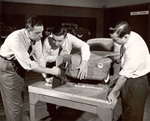

About the Project | Credits | Contact Us | Student & Teacher Resources | Site Map
©2004 Automobile in American Life and Society
